
Closing the Access Gap: How APC Organizations Can Ensure MSK Care Reaches Every Worker
For advanced primary care organizations partnering with employers, many teams don't realize that segments of their workforce are being left more vulnerable to MSK injury. Employees who work swing or night shifts, off-site, or remotely often can't access on-site or near-site clinics for preventive care or early-stage injuries. Learn how flexible MSK care options with 24/7 virtual access can close these gaps, support workforce equity, and reduce costs.
November 10, 2025
6 min. read
With the high prevalence of MSK issues across the workforce, employers understand the importance of injury prevention and rehab programs—and are increasingly investing in them. Yet many organizations are unintentionally leaving segments of their workforce behind.
Employees who work swing or night shifts, off-site, or remotely often find it difficult to access on-site or near-site clinics for preventive care or early-stage injuries. Workers might be hesitant to seek help when doing so means leaving the job site, losing pay, or traveling a long distance. In addition, even employees who work on-site might not have access to the education they need to understand the importance of injury prevention—or they might have a hard time accessing on-site MSK care due to long wait times or a busy work schedule.
For advanced primary care (APC) providers supporting employers, this gap in access creates a quiet but costly equity problem. Research shows that MSK disorders are a leading cause of missed work days, workers’ compensation claims, and staff turnover. According to the National Safety Council, overexertion and other MSK injuries cost U.S. employers more than $18 billion annually in lost productivity and absenteeism.1 When employees delay care for these issues, recovery times lengthen and the likelihood of reinjury or chronic pain increases.
In addition, employees dealing with untreated pain or limited mobility often experience lower morale. In one study, workers with limited access to workplace health resources—especially those in roles with fewer supports—reported higher stress, lower job satisfaction, and greater intent to leave.2
These inequities represent both a challenge and an opportunity for APC organizations. Solving this problem isn’t just about reducing costs—it’s also about creating a more equitable work environment and resilient workforce so that every employee has the same opportunity to prevent injury, recover fully, and stay engaged in their work. Let’s take a look at how digital MSK care solutions like Medbridge One Care can help.
How One Care Helps Expand Access
With Medbridge One Care, workers can access effective, evidence-based preventive and rehabilitative MSK care on their own schedule, no matter where or when they work.
This all-in-one solution combines our HEP Builder, Patient-Reported Outcomes (PROs), Remote Therapeutic Monitoring (RTM), and our innovative digital care Pathways into a single, seamless experience. Members follow daily, prescribed activities that improve function and mobility while care teams monitor impact at the population level. With One Care, APC organizations can offer scalable MSK care at the population level without sacrificing control of the member experience.
When every employee has a fair chance to manage early symptoms, prevent injury progression, and stay productive, employers benefit from:
Reduced preventable injuries and OSHA reportables.
Fewer avoidable referrals and imaging.
Lower rates of absenteeism and turnover.
Stronger employee satisfaction and loyalty.
Improved recruitment and retention due to a company culture of care and inclusivity—a strong differentiator in a competitive market.
Empowering Employees Through Knowledge and Autonomy
Whether they lift heavy equipment or spend long hours at a desk, employees put significant strain on their bodies every day. Industrial workers bend, carry, climb, and exert their muscles for long periods—while desk workers sit in static positions that can stress the spine, neck, and shoulders. In both cases, without the right conditioning, education, and support, workers are at risk for preventable injury.
APC organizations can change this trajectory by shifting to a sports medicine model that encourages awareness, confidence, and proactive self-care rather than waiting for pain to become a crisis.
One Care enables this approach by providing workers with:
An engaging experience that encourages a "daily vitamin" of exercises to avoid injury.
Interventions designed for real work scenarios, whether that’s repetitive lifting or a day filled with back-to-back meetings.
Personal progress tracking that builds a sense of autonomy, not surveillance, that helps employees feel supported rather than watched.
Education around early symptom recognition so that minor discomfort doesn’t become a lost-time injury.
This focus on prevention as empowerment pays off: Workers feel valued, capable, and confident advocating for their health. In addition, organizations benefit from a workforce that remains healthy, productive, and ready to perform safely and sustainably.
A Real-World Example: The Cost of Delayed MSK Care
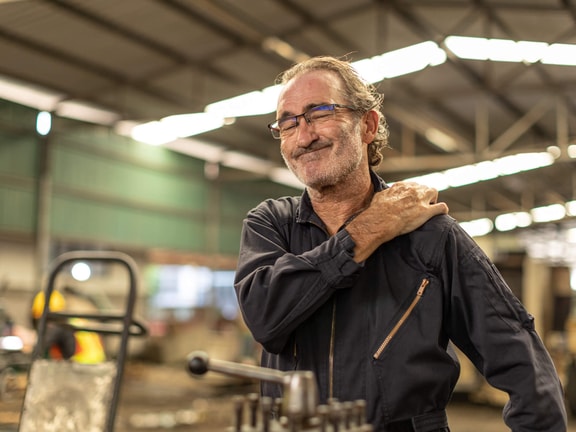
Mike is a 55-year-old heavy equipment operator who has spent decades working swing shifts at a major aerospace facility. His job requires long hours sitting in a cab, gripping controls, and constantly twisting to keep an eye on loads.
Over time, these movements begin to take a toll. Mike starts to notice soreness and stiffness in his shoulder, but his company's on-site clinic isn’t open during his shift. He doesn’t want to take time off or appear unable to keep up with younger co-workers, so he pushes through. Months later, a routine overhead reach results in a painful rotator cuff tear, the culmination of years of repetitive strain.
Now Mike is in pain, out of work, and facing surgery. The company loses a highly skilled operator and needs to pay workers' compensation costs while backfilling his role. A preventable issue has become a costly injury.
With One Care
Now imagine the same scenario with One Care in place:
Mike has been dealing with some mild discomfort in his shoulder, but because he’s enrolled in his department’s injury prevention program, he’s learned how to take micro breaks and prepare for his shift by warming up. The program is easy to access and use from anywhere, and involves exercises and education targeted to the type of work Mike does.
As a result, Mike’s shoulder pain doesn’t escalate into a serious problem that would involve prescribing care and become an OSHA recordable. He stays healthy and productive, his employer avoids lost-time and claims costs, and his long career remains on track.
Conclusion
Without flexible MSK care options that offer 24/7 virtual access, employers risk unintentionally excluding workers—including those working wing shift, off-site, or remotely—leaving them more vulnerable to injury. Equitable access to care isn’t just the right thing to do; it also strengthens workforce health and promotes organizational success.
Request a demo today to see how One Care can help your organization close this pervasive and costly care gap.
References
https://www.nsc.org/safety-first/address-workplace-inequities-to-reduce-ergo-injuri
https://www.sciencedirect.com/science/article/abs/pii/S0925753512001488
Meet the Author


Subscribe to Our Newsletter
Related Posts

June 20, 2025
Employer-Sponsored Advanced Primary Care (APC) and Advanced Primary Care Management (APCM)
By Medbridge

March 2, 2026
Medbridge Debuts MSK Solutions for the Industrial Athlete
By Medbridge

May 14, 2024
Patient Leakage 101: Why Are Hospitals Losing MSK Patients?
By Jon Ide-Don

December 21, 2023
Solve for Access, Engagement and Outcomes with Virtual Care Delivery
By Medbridge