
Lachman Test: Purpose, Procedure, and Clinical Relevance
November 10, 2025
7 min. read

The Lachman test is one of the most accurate manual examinations used to assess injury to the anterior cruciate ligament (ACL). It evaluates the amount and quality of anterior translation of the tibia relative to the femur, helping determine whether the ACL is intact or torn.
This article reviews the biomechanics behind the test, summarizes research on its diagnostic accuracy, provides a step-by-step procedure, and outlines its clinical applications and limitations.
1. Anatomical and Biomechanical Foundation
The ACL originates from the posteromedial aspect of the lateral femoral condyle and inserts into the anterior intercondylar area of the tibia, functioning primarily to resist anterior tibial translation and rotational instability¹.
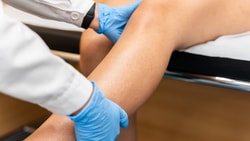
During the Lachman test, the knee is flexed to 20–30 degrees, minimizing the influence of the posterior capsule and menisci and allowing the examiner to isolate ACL movement². The examiner stabilizes the femur with one hand and applies an anterior force to the proximal tibia with the other, observing the amount of forward motion and the “endpoint” quality.
A firm endpoint suggests an intact ACL.
A soft or absent endpoint and increased anterior translation indicate ACL disruption².
By testing at slight flexion, the Lachman test better isolates ACL function than the anterior drawer test performed at 90°³.
2. Diagnostic Accuracy and Evidence
The Lachman test has consistently shown high diagnostic validity for identifying ACL tears. A systematic review and meta-analysis of clinical tests for suspected ACL injuries found the Lachman test to have the highest diagnostic accuracy among manual examinations⁴.
In a prospective study of 133 patients with suspected ACL injuries, the Lachman test demonstrated greater accuracy than the anterior drawer and lever sign tests when results were compared to MRI⁵.
Across multiple studies, sensitivity is typically reported between 77–85 percent, and specificity greater than 90 percent⁶. A 2024 validation study using arthroscopy as the gold standard reported a sensitivity of 81.8 percent and specificity of 95.2 percent⁷.
Reliability between examiners is also strong when clinicians are properly trained². However, accuracy can be affected by several variables:
Timing — acute swelling may limit motion and obscure translation.
Muscle guarding — particularly hamstring activation, can reduce apparent laxity.
Examiner technique — correct stabilization and patient relaxation are key⁸.
Free Meniscus Injury Exercises PDF
Fill out the form to unlock your free Free Meniscus Injury Exercises PDF!
3. Performing the Lachman Test
Setup and Positioning
Position the patient supine on an examination table.
Flex the knee to approximately 20–30°; a small towel under the knee may aid comfort and positioning.
Stabilize the distal femur with one hand while grasping the proximal tibia with the other, placing the thumb on the tibial tuberosity for tactile feedback⁹.
Execution
With the femur stabilized, apply a firm anterior pull on the tibia.
Observe the magnitude of translation and compare it with the contralateral knee.
Assess the endpoint feel—a firm stop implies an intact ligament, while a soft stop or excessive translation suggests ACL compromise².
Interpretation
> 2 mm difference in anterior translation compared with the uninvolved side indicates abnormal laxity³.
A soft or indistinct endpoint is highly suggestive of ACL tear⁸.
False negatives can occur when joint swelling or hamstring tension restricts tibial motion⁸.
Example Scenario
A recreational basketball player presents several days after a twisting knee injury. With the knee flexed to 25°, the examiner stabilizes the thigh and pulls the tibia forward. The involved knee demonstrates 5 mm greater translation than the opposite side and lacks a firm endpoint—findings consistent with a complete ACL rupture, later confirmed by MRI.
Variations and Instrumentation
Instrumented devices such as the KT-1000 arthrometer can measure anterior translation quantitatively, providing objective data for diagnosis and follow-up⁸. Some clinicians also perform a drop-leg Lachman when patient size or muscle guarding limits precision.
4. Clinical Applications and Limitations
Clinical Applications
The Lachman test is typically performed during acute knee evaluation following trauma involving pivoting, hyperextension, or deceleration. A positive test—defined by excessive anterior translation with a soft endpoint—supports suspicion of ACL rupture.
Its value extends beyond diagnosis:
Guides decisions about imaging (e.g., MRI) or orthopedic referral.
Assists in pre- and post-operative evaluation following ACL reconstruction.
Functions as part of a comprehensive ligament testing battery, alongside the pivot shift and anterior drawer tests⁴.
Limitations and Common Pitfalls
While the Lachman test offers strong diagnostic performance, several limitations should be recognized:
Hemarthrosis or swelling can stiffen the joint and mask instability⁸.
Muscle guarding may limit tibial translation and yield false-negative results⁸.
Examiner experience influences inter-rater reliability; proper training improves consistency⁸.
Partial or chronic tears may produce less obvious motion due to secondary stabilizers and scar tissue formation.
The test should not be interpreted in isolation—clinical history and imaging remain essential for confirmation.
Best-Practice Integration
When incorporating the Lachman test into clinical evaluation:
Always compare both knees—some patients have natural laxity differences.
Perform the test as early as feasible, before swelling increases.
Document both translation magnitude and endpoint quality.
Combine findings with patient history, mechanism of injury, and functional limitations.
Communicate results clearly with interdisciplinary team members for care coordination.
The Lachman Test is just one of many tools available to help clinicians diagnose and manage musculoskeletal conditions with greater precision. At Medbridge, we equip providers with the knowledge and resources they need to elevate care—from exam technique to evidence-informed decision-making.
Ready to enhance your orthopedic assessment skills?
Subscribe today to unlock full access to our comprehensive library of orthopedic special tests, including video demonstrations, clinical pearls, and expert-led guidance to support confident diagnosis and effective treatment planning.
To continue building your clinical expertise, visit our PT CEU page for in-depth courses, certifications, and guided learning paths.
References
Logerstedt DS, et al. Evidence-based recommendations for ACL injury diagnosis and management. J Orthop Sports Phys Ther. 2011;41(10):A1–A37. https://www.jospt.org/doi/10.2519/jospt.2011.3761
National Center for Biotechnology Information (NCBI). Anterior Drawer and Lachman Tests. In: StatPearls [Internet]. 2024. https://www.ncbi.nlm.nih.gov/books/NBK554415/
Logerstedt DS, et al. Evidence-based recommendations for ACL injury diagnosis and management. J Orthop Sports Phys Ther. 2011;41(10):A1–A37. https://www.jospt.org/doi/10.2519/jospt.2011.3761
Smith TO, et al. Diagnostic accuracy of physical examination tests for suspected acute anterior cruciate ligament injury: a systematic review and meta-analysis. Int J Sports Phys Ther. 2022;17(4):620–632. https://ijspt.scholasticahq.com/article/36434
Iqbal A, et al. Clinical Examination in the Diagnosis of Anterior Cruciate Ligament Injury. JAAOS Global Res Rev. 2023;7(2). https://journals.lww.com/jaaosglobal/fulltext/2023/02000/clinical_examination_in_the_diagnosis_of_anterior.6.aspx
Logerstedt DS, et al. Evidence-based recommendations for ACL injury diagnosis and management. J Orthop Sports Phys Ther. 2011;41(10):A1–A37. https://www.jospt.org/doi/10.2519/jospt.2011.3761
Ali S, et al. Diagnostic Accuracy of Lachman Test for Diagnosis of Anterior Cruciate Ligament Tear in Adults Using Arthroscopy as Gold Standard. Pak J Med Sci. 2024. https://www.researchgate.net/publication/380555292
Imran R, et al. Accuracy of ACL Special Tests in the Presence of Hemarthrosis. Int J Sports Exerc Med. 2019;5(132). https://clinmedjournals.org/articles/ijsem/international-journal-of-sports-and-exercise-medicine-ijsem-5-132.php
National Center for Biotechnology Information (NCBI). Anterior Drawer and Lachman Tests. In: StatPearls [Internet]. 2024. https://www.ncbi.nlm.nih.gov/books/NBK554415/
Meet the Author


Subscribe to Our Newsletter
Related Posts
March 9, 2025
Anterior Drawer Test: What Physical Therapists Should Know About ACL Screening
By Medbridge

September 9, 2024
Top 10 Essential Strategies for ACL Rehabilitation Success
By Kyle Matsel PT and Phil Plisky

July 10, 2026
Valgus Stress Test: Assessing Medial Knee Stability
By Medbridge

March 13, 2025
Empty Can Test: Purpose, Procedure, and Clinical Considerations for Physical Therapists
By Medbridge