
Medbridge vs HEP2go: Which Home Exercise Program Fits Your Needs?
Get a comprehensive comparison of Medbridge vs HEP2go, covering home exercise delivery, patient engagement tools, and organizational fit.
January 8, 2026
8 min. read
.jpg)
Selecting the right home exercise program (HEP) platform can influence patient participation, daily workflows, and the consistency of care across teams. Medbridge and HEP2go are two widely used options, each offering a way to build and deliver structured home programs. While both platforms provide exercise libraries and program-building tools, they differ significantly in content quality, scalability, patient education offerings, and long-term suitability for organizations.
This article examines Medbridge vs HEP2go, focusing on exercise content, program-building workflows, engagement tools, administrative capabilities, pricing considerations, and organizational needs. Side-by-side feature comparisons, pricing considerations, and example scenarios are woven into the review to help you evaluate the right platform for your environment.
Overview of Medbridge and HEP2go
Medbridge
Medbridge Care features a robust HEP solution tailored for individual clinicians and organizations seeking more than a basic exercise builder. Its HEP functionality features thousands of professionally filmed exercise videos, pre-built templates, and integrated patient education to support engagement and adherence, with the ability to support remote therapeutic monitoring (RTM) workflows through Medbridge's RTM solution. Clinicians can assign exercises, track patient-reported outcomes, and manage patient lists and profiles within a single workflow with easy-to-use EMR integrations, administrative dashboards, and user permissions. As practices grow, Medbridge Care can scale beyond HEPs to include guided care pathways.
Medbridge also offers a comprehensive Educate solution for organizations wanting to access both patient care and clinician education on a single platform. Educate includes accredited continuing education (CEUs) and a learning management system (LMS) for staff training, compliance tracking, and skills development.
HEP2go
HEP2go is a budget-friendly tool designed for clinicians who want a simple way to build and share home exercise programs. It allows users to build HEPs by selecting exercise illustrations or videos and adding custom-written instructions. The platform is primarily focused on basic HEP delivery and does not include integrated patient education, outcomes tracking, RTM, or clinical management tools. HEP2go is best suited for individual clinicians or small practices with simple HEP needs and limited workflow requirements.
Exercise Libraries and Program Development
Exercise Content
Medbridge offers a robust exercise library covering a wide range of musculoskeletal conditions and use cases focused on acute, chronic, post-surgical, and preventive care. The library includes mobility, strengthening, balance, and functional exercises, along with condition-specific progressions that support different stages of care. Exercises are demonstrated by real patients, with clinician guidance to reinforce proper form, pacing, and safety. Pre-built templates help clinicians quickly create complete programs, and content is regularly updated to reflect current clinical standards.
HEP2go uses video demonstrations of movements and exercises that work well for basic strengthening and mobility activities. However, its library is more limited in scope, with fewer condition-specific progressions and templates. As a result, relevant exercises may not be available or may be more challenging for patients to understand when they need to perform multi-step, functional, or dynamic movements, particularly when clinical context or progression guidance is required.
Program Customization
Medbridge HEP includes condition-specific templates and customizable tools that help clinicians quickly build and reuse high-quality home exercise programs. Clinicians can adjust dosage, cues, frequency, sets, reps, and other parameters, and save favorite programs as templates that promote consistency across providers. The HEP builder also provides smart exercise suggestions based on selections, and programs can be updated over time as patients make progress.
HEP2go enables clinicians to create customized programs by selecting illustrations and tailoring instructions. It offers fewer templates and does not provide built-in exercise suggestions or reusable programs, so clinicians manually manage progression and consistency.

Patient Engagement and Digital Tools
Patient Experience
Medbridge offers a mobile app and patient portal that provide easy-to-access video demonstrations, reminders, and a clean interface. These tools help reduce guesswork for patients completing exercises at home.
HEP2go relies on PDFs or printed sheets. Patients receive the program manually via email or paper copy, and follow-up depends on in-clinic communication.
Administrative and Enterprise Tools
Medbridge HEP includes:
Modern mobile-responsive builder
Suggested exercises
A patient chart (for quick access to AI summaries, patient feedback, and insights)
Patient-specific programs
Multiple episodes of care
Care Teams (for assigning multiple clinicians to a single patient)
Single Sign-On (SSO)
Admin roles
Reporting
EMR integrations
Digital HEP sharing
Automatic program documentation
People management
Utilization analytics
HEP2go offers:
Illustration-based HEP builder
Basic digital HEP sharing
No integrations
No enterprise administration tools
Side-by-Side Comparison Chart: Medbridge vs HEP2go
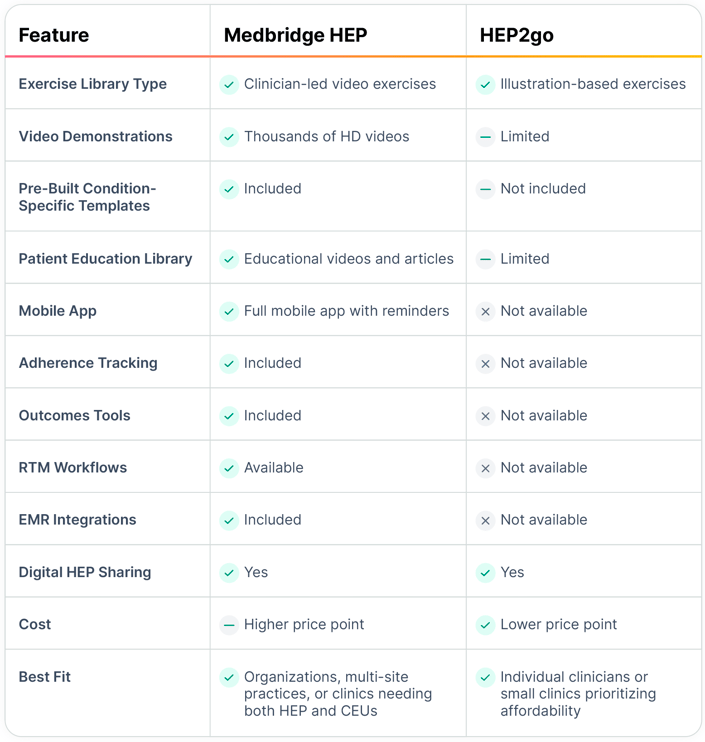
Pricing Considerations
HEP2go offers a free version, with a Pro option available for approximately $7 per month. This pricing makes it an attractive option for individual clinicians or small clinics seeking the lowest-cost way to create and send basic home exercise programs, with minimal additional functionality.
Medbridge’s HEP solution is available through its Care subscriptions. The Care Essentials plan includes HEP functionality, along with patient outcomes tools, patient list and management tools, and integrations and support, making it a suitable solution for organizations seeking an effective, all-in-one solution. The Care Elite plan builds on these capabilities with additional advanced features such as RTM and guided care pathways.
While Medbridge costs more than basic HEP-only tools, its pricing reflects the inclusion of multiple capabilities designed to help clinicians deliver high-quality care and optimize patient engagement. For more information, please visit our Plans & Pricing page.
Common Questions
When clinicians and clinics compare Medbridge and HEP2go, the decision often comes down to cost, scope, and long-term needs. Below are some of the most common questions prospective users raise, and how each platform typically fits those priorities.
HEP2go is much cheaper. Why would I pay more for Medbridge?
HEP2go is one of the lowest-cost options available for building and sharing basic home exercise programs. For clinicians whose primary need is creating simple illustrated HEPs, affordability can be appealing.
Medbridge, however, is designed for clinicians and organizations that require a higher level of functionality. HEP2go relies primarily on illustrations and basic videos, which can be sufficient for simple exercises. Medbridge offers a much broader library of professionally produced videos with clinical context and progression guidance. For many patients—especially those managing complex, post-surgical, or chronic conditions—clear visual instruction can improve confidence, accuracy, and adherence.
In addition to HEP creation, Medbridge includes features such as video-based patient education, outcomes tracking, administrative tools, EMR integrations, and the option to add RTM workflows, clinician continuing education, and staff training. For many clinics, this means fewer platforms to manage and a more consistent experience for both patients and staff.
HEP2go works well for individual clinicians. Is Medbridge overkill?
For solo clinicians or small practices with straightforward needs, HEP2go can be a suitable solution. It’s simple, quick to use, and easy to share with patients via PDF or email—often enough for basic exercise instruction.
That said, the question for many clinicians is not whether a program provides basic functionality but whether it can truly help patients succeed. Even small differences in how exercises are presented and supported can influence patient understanding, confidence, and follow-through.
Medbridge is often a better fit when:
Patients benefit from clear, high-quality video instruction that shows proper form, pacing, and progression—not just static images
Education and reminders help reinforce care outside the clinic, especially for patients managing pain, recovery, or chronic conditions
Clinicians want insight into adherence and the patient experience, so care can be adjusted as needed
Multiple clinicians need to deliver a consistent experience, helping patients feel supported no matter who they see
Practices are planning to grow or standardize care without sacrificing quality or personalization
For many clinics, a modest investment in additional functionality can lead to improved patient understanding, increased engagement, and enhanced satisfaction—all of which contribute to stronger outcomes.
What about data security and patient privacy?
When handling sensitive patient information, security and compliance are top priorities for clinics. Medbridge’s platform is HITRUST CSF® certified, designed to support HIPAA-compliant storage and use of Protected Health Information, and includes a Business Associate Agreement with its service agreement. Medbridge also offers HIPAA and security-focused training resources to help practices enhance their own compliance.
While no system can guarantee complete protection from unauthorized access, selecting a platform specifically designed for healthcare compliance can provide clinics with greater confidence in managing patient data.
Example Scenario: Creating a Home Exercise Program
For a patient needing a knee osteoarthritis program:
Using Medbridge
A clinician selects a template, adjusts parameters, adds a video-based education piece, and delivers it through the mobile app. The patient follows videos tailored for their condition and receives regular reminders. The clinician is able to track pain, difficulty, and adherence, and review completion data.
Using HEP2go
A clinician selects illustrated exercises, adjusts dosage, and sends a PDF or printed sheet. Progress updates rely on in-clinic conversation, and adjustments are made manually.
When comparing Medbridge vs HEP2go, both platforms offer HEP creation, but the focus and depth differ. HEP2go is a simple, low-cost tool for clinicians who want an affordable, illustration-based HEP builder. Medbridge offers a comprehensive ecosystem, including video-based exercises, outcomes tracking, integrations, RTM support, and optional clinician education, making it more suitable for clinics or organizations seeking to optimize patient engagement and consolidate multiple needs under a single platform.
For teams prioritizing high-quality content, stronger patient engagement, and scalable workflows, Medbridge offers a more complete solution.
Meet the Author


Subscribe to Our Newsletter
Related Posts

July 26, 2022
The Importance of Home Exercise Programs in Outpatient Rehab
By Medbridge

August 26, 2021
The Healthcare Technology Checklist: Virtual Care Tools to Improve Patient Engagement
By Medbridge

December 22, 2022
6 Strategies to Ease Staff Burden with Digital Healthcare Technology
By Medbridge

March 6, 2023
5 Tips to Retain Patients & Enhance the Patient Experience
By Medbridge