
Medbridge vs Summit Education: A Detailed Comparison for Clinicians
Select the right continuing education platform for your needs with this comprehensive overview of the key differences between Medbridge and Summit Education.
March 18, 2026
10 min. read

When selecting a continuing education platform, clinicians often balance several competing priorities: access to quality courses, flexibility around busy schedules, ease of meeting CE requirements, and tools that support patient care beyond coursework. Two platforms commonly considered for these needs are Medbridge and Summit Education.
While both platforms are commonly used by physical and occupational therapy professionals, Medbridge also supports continuing education across additional clinical disciplines such as athletic training, nursing, and speech-language pathology. Differences between Medbridge and Summit Education are most noticeable in how education is accessed, how it fits into day-to-day clinical routines, and how supporting tools, such as home exercise programs (HEPs), are integrated.
In this article, we’ll take a look at:
How and when education is delivered
Course library size and learning formats
HEP support
Practical considerations around cost and long-term use
Organizational support and standardization
1. How Education Fits Into a Clinician’s Schedule
One of the clearest differences between Medbridge and Summit Education is how learning is designed to fit into clinicians’ schedules—including not only when education happens, but also how content is delivered.
Medbridge: Flexible, Multi-Format Learning
Medbridge is built around an on-demand learning model designed to support flexible, self-paced education. The platform offers more than 3,000 courses across a range of clinical and professional topics, allowing clinicians to complete coursework whenever their schedule allows.
In addition to traditional video courses, Medbridge provides multiple content formats designed for different learning preferences and time constraints, including:
Short-form microlearning courses
Podcast-style audio learning
Full-length video courses
Live webinars (75+ annually)
Structured certificate tracks
Exam preparation programs for specialty certifications
This range of formats allows clinicians to engage with education in different ways—whether completing a full course session, reviewing a short clinical concept between patients, or listening to educational content during commutes or workouts.
Courses can be accessed through a web browser or mobile app, with offline access available for certain content. This structure may appeal to clinicians who want education that fits into small windows of time rather than requiring scheduled attendance.
Summit Education: Live Learning Emphasis
Summit Education places a stronger emphasis on live learning experiences. The platform offers 200+ live webinars annually, along with in-person seminars in many regions. These are supplemented by a library of 600+ on-demand courses.
For clinicians who value real-time instruction, scheduled sessions, or in-person learning environments, Summit’s model may feel familiar and engaging. They also provide virtual access for in-person courses. Live sessions may also appeal to those who prefer set deadlines or interactive Q&A formats.
Education Delivery Comparison
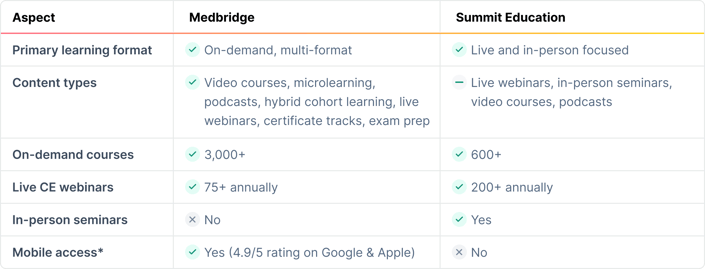
*Medbridge Clinician Mobile App has offline capabilities to view mobile courses while on the go.
2. Course Library Breadth and Content Variety
Beyond format, clinicians often compare platforms based on how much content is available and how diverse it is.
Medbridge
Medbridge offers one of the largest fully online healthcare CE libraries, with more than 3,000 on-demand courses and educational resources spanning multiple disciplines and clinical settings. The platform offers content on a broad range of evidence-based topics designed for physical therapists, occupational therapists, speech-language pathologists, athletic trainers, nurses, and other healthcare professionals.
Content areas extend beyond musculoskeletal rehabilitation to include:
Neurologic rehabilitation and stroke care
Pediatrics and early intervention
Geriatrics and dementia care
Pelvic health
Acute care and critical care rehabilitation
Home health and hospice practice
Pain science and behavioral considerations in rehab
Clinical supervision, compliance, and professional development
Behavioral and mental health topics
Counseling-informed clinical skills
Fitness, wellness, and performance training concepts
Medical screening and differential diagnosis
Interdisciplinary healthcare topics
Courses are delivered primarily through on-demand video instruction led by recognized clinical experts, with new content added regularly based on industry research and clinician demand.
Because the library spans introductory through advanced material across specialties, clinicians often use Medbridge not only to complete required CE credits but also to explore new practice areas, reinforce clinical reasoning skills, prepare for specialty certifications, or build professional development plans over several years.
This breadth can reduce the likelihood that clinicians “outgrow” the platform after one or two renewal cycles, particularly for providers seeking ongoing professional development rather than isolated CE courses.
Summit Education
Summit offers a smaller but diversified subject mix across healthcare, behavioral health, and wellness topics, delivered through a combination of live seminars, webinars, and online courses.
In addition to rehabilitation-focused education for PT, OT, and related professions, Summit’s catalog includes coursework in areas that extend beyond traditional rehab CE libraries, such as:
Behavioral and mental health topics
Counseling-informed clinical skills
Fitness, wellness, and performance training concepts
Medical screening and differential diagnosis
Interdisciplinary healthcare topics
Many Summit courses are built around live, instructor-led experiences, including in-person seminars with lectures, case discussions, and hands-on lab components. This format may appeal to clinicians who prefer face-to-face instruction, need live CE hours for licensure requirements, or value intensive single-day or weekend learning events.
Because Summit frequently aligns course offerings with touring seminars and scheduled webinars, the library may feel more event-driven and topic-specific compared with large on-demand platforms. This structure can work well for clinicians seeking targeted education on a specific topic or upcoming skill area rather than continuous, self-paced learning across multiple specialties.
3. Home Exercise Programs and Clinical Workflow
Some clinicians also consider whether a CE platform supports HEP creation, especially if they prefer fewer tools in their day-to-day workflow.
Medbridge: Native HEP Integration
Medbridge includes a native HEP builder built directly into the platform. With a Premium subscription, clinicians can access their CE content and assign exercise programs alongside patient education materials—without relying on third-party systems. Because the HEP tool is part of the same platform as education content, workflows remain consolidated.
This setup may be useful for clinicians who want education and patient-facing tools in one place.
Medbridge’s robust HEP solution is tailored for individual clinicians and organizations seeking more than a basic exercise builder. Its HEP functionality features thousands of professionally filmed exercise videos, pre-built templates, and integrated patient education to support engagement and adherence, while also supporting remote therapeutic monitoring (RTM) workflows through Medbridge's RTM solution.
Clinicians can assign exercises, track patient-reported outcomes, and manage patient lists and profiles within a single workflow with EMR documentation support, administrative dashboards, and user permissions.
Summit Education: Partnered HEP Solution
Summit Education’s HEP offering is delivered through a partnership with Wibbi, rather than a fully native tool. While this provides access to a known exercise database, it introduces an additional system into the workflow.
For clinicians who already use Wibbi or do not rely heavily on digital HEP tools, this may not present an issue. Others may prefer a single-platform experience.
HEP Comparison
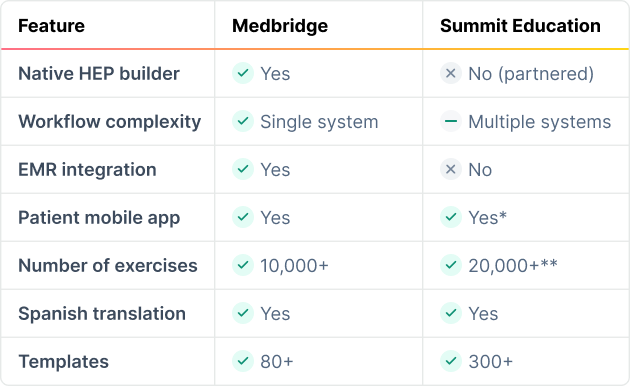
*Available via Summit’s third-party HEP partner, Wibbi.
**$9.99-per-month additional charge for Home Exercise Program.
4. Cost and Long-Term Practical Use
Pricing often plays a role, especially for individual clinicians paying out of pocket.
Summit Education
Summit Education offers several subscription tiers ranging from online-only access to a comprehensive All Access plan that includes in-person, live virtual, and online courses.
Pricing:
$269.99 per person/year for Online Access
$299.99 per person/year for Virtual Access
$319.99 per person/year for All Access
Individual Summit Education courses are also available for purchase, typically ranging from $49.99 to $269.99 depending on course format and credit hours.
Medbridge
Medbridge pricing might appear higher at first glance, but that difference narrows when considering what is included. Medbridge’s Premium subscription includes access to its HEP tools, whereas Summit Education charges an additional $9.99 per month for optional HEP access. This equals $439.99 per person per year for an All Access plan plus HEP. For clinicians who regularly use both continuing education and HEP functionality, having these tools bundled into a single subscription can simplify workflows and reduce total monthly costs compared with paying separately for education and exercise programming.
Considerations beyond price:
Time saved searching for courses. A large, searchable on-demand library helps clinicians quickly find eligible CE credits without coordinating schedules or searching across multiple providers.
Reduced need for multiple tools. Combining continuing education, patient education, and HEP tools into a single platform reduces system switching and simplifies daily workflows.
Access to education at any time, rather than around schedules. On-demand learning lets clinicians complete coursework at their convenience, without planning around live events, travel, or fixed schedules.
5. Organizational Support and Standardization
While individual clinicians often focus on flexibility and CE access, healthcare organizations typically evaluate platforms differently. Beyond course libraries and HEP tools, organizations may need infrastructure that supports onboarding, compliance tracking, and standardized skill development across teams.
Medbridge
Medbridge offers organizational features designed to support onboarding and workforce development. These include:
A native learning management system (LMS)
Historical completion reporting for compliance tracking
Administrative dashboards and user permissions
These capabilities allow organizations to assign required education, monitor completion over time, and maintain documentation for accreditation or regulatory purposes. This centralized oversight can reduce administrative burden while supporting consistent clinician development.
Summit Education
Summit Education is primarily structured around individual subscriptions and live course participation. While clinicians can complete CE requirements and download certificates, Summit does not provide a native LMS, historical reporting infrastructure, or skills tracking tools designed for organizational standardization.
For teams seeking enterprise-level oversight, onboarding pathways, and ongoing competency management, this difference may be an important consideration.
Choosing the Right Platform for How You Learn and Work
Consider two clinicians renewing licensure this year:
Clinician A prefers short, focused courses that they can complete between patients or after work, revisiting topics as needed. They occasionally attend live webinars but prioritize flexibility and on-demand learning. They also value having patient care tools—such as a home exercise program (HEP)—integrated alongside their education resources to support clinical workflow. This clinician may lean toward Medbridge.
Clinician B enjoys scheduled learning experiences, including live instruction, webinars, and occasional in-person seminars. They appreciate structured learning environments and the interaction that comes with real-time instruction, and are primarily focused on continuing education rather than integrated digital tools. This clinician may find Summit Education aligns well with their preferences.
When comparing Medbridge vs Summit education, the decision often comes down to how clinicians prefer to learn and work—and how closely they want education connected to daily patient care.
Medbridge emphasizes on-demand education, a large course library, and integrated tools that support both learning and patient care.
Summit Education emphasizes live and in-person CE experiences, with a smaller on-demand library and a more traditional learning structure.
Neither approach is inherently better. Clinicians—and the organizations that support them—benefit most when the platform aligns with learning habits, scheduling needs, and the way education fits into everyday clinical practice.
Organizations should consider operational complexity, compliance requirements, and care delivery models when selecting a platform. Aligning these factors with the platform’s capabilities supports sustainable clinician development and consistent patient care delivery.
Meet the Author


Subscribe to Our Newsletter
Related Posts

June 23, 2026
CE Access Was Just the Starting Line: Turning Continuing Education Into a Clinical Retention Engine
By Andrew Mickus
August 3, 2022
Continuing Education in Healthcare: What You Need to Know
By Medbridge
.jpg)
January 8, 2026
Medbridge vs HEP2go: Which Home Exercise Program Fits Your Needs?
By Medbridge

August 26, 2021
The Healthcare Technology Checklist: Virtual Care Tools to Improve Patient Engagement
By Medbridge