
New APTA Report Reveals Payer Administrative Burden Continues to Strain Physical Therapists and Impede Patient Care
The Impact of Administrative Burden on Physical Therapist Services, a newly released report from the American Physical Therapy Association, provides a comprehensive examination of how payer-imposed requirements are increasingly straining physical therapist practices and restricting patients’ access to timely, effective care.
November 12, 2025
3 min. read

The Impact of Administrative Burden on Physical Therapist Services, a newly released report from the American Physical Therapy Association, provides a comprehensive examination of how payer-imposed requirements are increasingly straining physical therapist practices and restricting patients’ access to timely, effective care.

Download the full report and accompanying infographic.
The new report analyzes findings from APTA’s third administrative burden survey, conducted in mid-2025, and compares the results with those from previous surveys conducted in 2018 and 2022. The survey, distributed to nearly 19,000 physical therapists across various practice settings, provides a seven-year perspective on the growing challenges posed by prior authorization, documentation, appeals, and other payer-related demands.
“The data is clear—administrative burden is excessive, unsustainable, and continues to hinder both physical therapists and the patients they serve,” said APTA President Kyle Covington, PT, DPT, PhD. “Without meaningful reform, these barriers will continue to strain the workforce and impede timely access to care.”
Key Report Findings
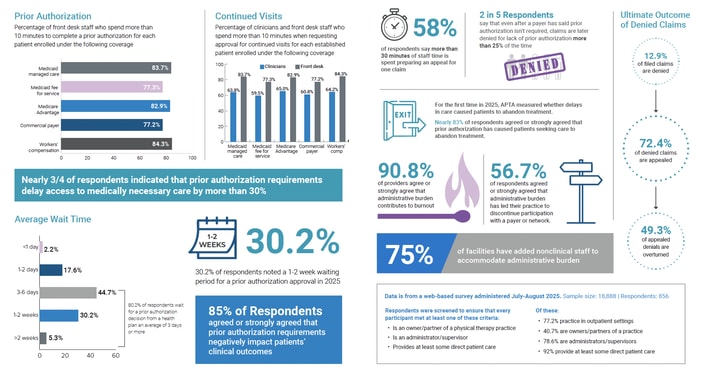
Delays are increasing: Nearly one in three physical therapists now report waiting one to two weeks for prior authorization approval—up 9 percentage points since 2018.
Patient outcomes are worsening: 85 percent of respondents reported that prior authorization negatively affects patients’ clinical outcomes.
Patients are abandoning care: 83 percent of respondents agreed or strongly agreed that authorization delays have caused patients to stop treatment altogether.
Operational strain: Three out of four practices have hired administrative staff solely to manage payer requirements, diverting resources from patient care.
Rising costs and burnout: 57 percent of respondents reported that administrative burden has forced their practice to discontinue participation with at least one payer network.
The report underscores how administrative tasks, such as prior authorization, appeals, and documentation requirements, pose more than just an inconvenience to providers— they are a growing threat to patient access and outcomes in physical therapy.
An accompanying infographic illustrates the state of administrative burden in 2025, detailing the effect on both providers and patients.
Use This Report to Drive Policy Change
The Impact of Administrative Burden on Physical Therapist Services Report is a resource for every provider and advocate seeking to improve patient access and practice sustainability.
Use this report in advocacy to:
Show payers that excessive and unnecessary administrative requirements harm outcomes and discourage patients from accessing care.
Urge lawmakers to require transparency, consistency, and timeliness in payer processes.
Demonstrate for payers, regulators, and policymakers how administrative burden fuels provider burnout and undermines patient outcomes.
Use this report alongside APTA’s companion publications—The Economic Value of Physical Therapy in the United States and the State of Direct Access to Physical Therapist Services—to make the case for reform with policymakers, payers, and partners.
“Reducing administrative burden is central to APTA’s strategic priority of improving payment across all payers and regulatory reforms,” Covington added. “By streamlining these requirements, we empower physical therapists to focus on patient care, improve financial sustainability, and ensure patients receive the services they need, when they need them.”
Download the full report and accompanying infographic.
Meet the Author


Subscribe to Our Newsletter
Related Posts

February 7, 2024
New CMS Final Rule: Is the Burden of Prior Authorization Finally Over?
By Medbridge

May 14, 2024
Patient Leakage 101: Why Are Hospitals Losing MSK Patients?
By Jon Ide-Don

May 11, 2026
Medbridge Debuts First Rehabilitation and Physical Therapy Care Intelligence Loop
By Medbridge

June 10, 2021
Putting the PI in QAPI: Performance Improvement in Home Health
By Joseph Brence