
Falls Efficacy Scale-International: Bridging the Gap Between Physical Function and Patient Confidence
June 24, 2026
10 min. read
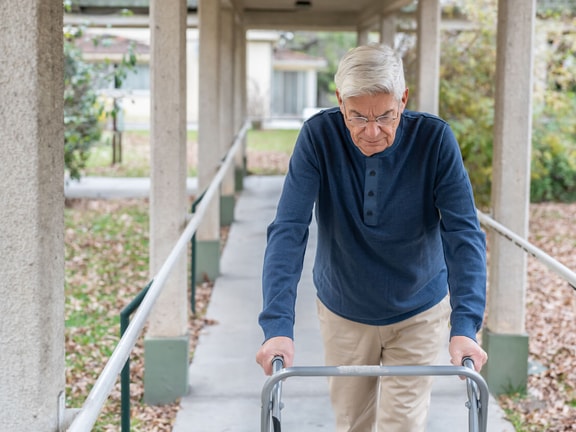
Fear of falling is often a hidden barrier to recovery. It can restrict mobility and social participation just as much as a physical impairment, leading to a downward spiral of deconditioning and increased risk. For many older adults, the fear itself—rather than a lack of strength—is what ultimately leads to a loss of independence.
Because of this, a truly effective fall risk assessment has to go beyond gait speed, medication list, and history. It has to capture the patient’s internal “safety thermostat,” essentially how confident they actually feel while navigating the world.
The Falls Efficacy Scale-International (FES-I) is a patient-reported outcome measure that provides a structured way to quantify this. Developed by the Prevention of Falls Network Europe, it is validated for adults ages 60 to 95 and is widely used across rehabilitation and community care because it looks at the patient’s life both inside and outside the home.1
In this article, we will break down the scoring and interpretation of the FES-I, explore why addressing fear of falling is a clinical priority, and demonstrate how to translate these scores into highly specific, actionable care plans. Plus, you’ll find a downloadable PDF version of the tool to use in your own practice.
What the Falls Efficacy Scale-International uncovers
The FES-I measures a person's level of concern about falling across 16 everyday activities. While some tools focus only on basic self-care, the FES-I includes higher-level physical tasks and community-based activities.
These items range from:2
Instrumental activities of daily living, such as cleaning the house, preparing meals, and getting dressed.
Functional mobility, such as walking on uneven surfaces or going up and down stairs.
Social participation, such as visiting friends, relatives, or attending a social event.
This distinction is vital for getting a true picture of your patient. You’ll often see a patient who performs beautifully during a clinic-based balance test but admits on the FES-I that they avoid leaving the house entirely. That gap between physical capacity and functional confidence is where the FES-I is most valuable, as it identifies the safe world the patient has built for themselves, which may be much smaller than their physical abilities suggest.
To use the FES-I in your clinic, you can download a printable version of the 16-item scale. Having this available during the initial evaluation allows you to establish a psychological baseline alongside your physical objective measures.
Falls Efficacy Scale International
Fill out the form to unlock your free Falls Efficacy Scale International PDF!
How to score the Falls Efficacy Scale-International
Patients rate their concern for each activity on a four-point scale:
1: Not at all concerned
2: Somewhat concerned
3: Fairly concerned
4: Very concerned
The total score is calculated by adding the item scores. Scores range from 16 to 64, with higher numbers signaling a higher psychological barrier to activity.2
It is important to remember that the FES-I is not a replacement for performance-based measures like gait speed, the Timed Up and Go (TUG), the Berg Balance Test, or strength assessments. Instead, it adds a necessary layer: the patient’s perspective. This helps the care team identify fear and perceived safety as the unseen factors that often dictate a patient's level of participation, their adherence to a home program, and their overall functional outcomes.3
Scoring ranges and clinical interpretation
Scoring the FES-I is straightforward, but the interpretation requires looking at the full clinical picture.
Score range | Interpretation |
16 | No concern about falling |
17 to 19 | Low concern |
20 to 27 | Moderate concern |
28 to 64 | High concern |
While these cut points help categorize concern levels, they shouldn't be used in a vacuum. A patient with a moderate score might still harbor high concern for one specific, essential task, such as navigating the front steps. Conversely, a high score might reflect a recent hospitalization or a “near-miss” that has temporarily shaken a patient’s confidence.
A note on missing items: If a patient skips one or two questions, don't toss the form. If four or fewer items are missing, you can calculate the mean of the completed items and multiply by 16 to estimate the total score. If more than four are missing, the score shouldn't be used for clinical decision-making.2
For a quicker screen, the Short FES-I (seven items, scored 7 to 28) is a feasible option for assessing fear of falling in older persons, though the full version is still the gold standard when you need granular detail for a care plan.4
Why fear is a clinical priority
We know that a single fall can lead to a permanent shift in a patient’s activity level, and not just because of the physical trauma. Falls are preventable through proactive screening, risk reduction, and targeted interventions, but we can’t prevent what we don’t measure.5 Without a tool to quantify confidence, we are essentially guessing at why a patient might be hesitant to progress.
Fear of falling is a central piece of this risk profile. It isn't always tied to a previous fall; it often stems from dizziness, visual impairment, or those “near-misses” that a patient might not think to report. When fear leads to reduced activity, the person loses strength, endurance, and balance, creating a self-reinforcing cycle of decline.
By using the FES-I, you can:
Catch silent avoiders: Identify those who stay home to stay safe but are deconditioning as a result.
Track changes in confidence over time: Monitor whether your interventions are actually making the patient feel safer, which is often the biggest hurdle to compliance.
Identify task-specific triggers: Pinpoint exactly which activities (like navigating stairs versus attending social events) require targeted intervention.
Support conversations: Use the objective score as a non-confrontational bridge to discuss activity avoidance and personal goals.
Guide comprehensive care: Use the results to justify specific home exercises, balance training, patient education, and environmental modifications tailored to their highest-concern tasks.
Document meaningful change: Even if a patient’s TUG score doesn’t move significantly, a lower FES-I score provides patient-reported evidence that they are becoming more functionally independent and ready for community re-entry.
Clinical case study: Translating scores into care
Consider a patient who recently finished outpatient therapy after a fall. They walk independently on level surfaces and their TUG score suggests low risk. However, they’ve stopped going to the grocery store or visiting friends.
Their FES-I score is 31 (high concern), with the highest anxiety focused on stairs and social events. In this case, the physical tests offered an incomplete picture. The patient isn't truly “recovered” because they are still housebound by fear.
The resulting care plan becomes much more specific:
Task-specific training: Transition from level-surface gait to stair practice and uneven-surface training.
Environmental education: Review safe pacing, proper footwear, and home/community safety.
Gradual exposure: Create a graded plan for avoided activities (for example, walking to the mailbox, then the corner, then the store).
If a reassessment shows the score dropped to 23 (moderate concern), you have objective proof that the patient is safer and more ready for community participation, regardless of whether their raw muscle strength changed.
Best practices for the FES-I workflow
The Falls Efficacy Scale-International is most effective when integrated into a broader fall risk workflow, such as the CDC’s STEADI initiative. STEADI provides a roadmap for standardized screening and intervention, and the FES-I adds the crucial "missing link" of patient confidence to that data.5
When combined with fall history, medication reviews, and physical assessments of vision and gait, the FES-I helps create a truly 360-degree view of a patient’s risk profile.
To get the most value from the tool in your practice:
Administer it consistently: Use the same version (full versus short) at each assessment point. Switching between the two mid-treatment makes longitudinal progress tracking difficult and can muddy your documentation.
Review item-level patterns: The total score is a clinical red flag, but the individual items are the roadmap. A high total score tells you there's a problem; seeing a 4 on the walking on uneven surfaces item tells you exactly what to treat.
Pair perception with performance: Patient-reported data shows perceived concern, while physical tests show observed function. Using these in tandem provides a more comprehensive view of risk, ensuring you aren't treating a score as a standalone decision point but rather as one vital piece of a larger clinical puzzle.3
Guide patient education: Use high-concern items to open non-confrontational conversations about safety strategies and goals that actually matter to the patient. It’s a great way to move the conversation from “you need to do this exercise” to “this exercise will help you feel safer when you visit your friends.”
Document for progress: Repeating the FES-I every few weeks allows you to document psychological gains. For many patients, seeing their concern score drop is a powerful motivator that encourages continued adherence to their program.
How FES-I results can support documentation and program planning
Beyond the initial evaluation, the FES-I serves as a powerful tool for objective documentation and high-level program evaluation. At the individual level, it provides patient-reported evidence of barriers that observation alone might miss. This is particularly useful for justifying medical necessity. If physical metrics like strength have plateaued but the FES-I score remains in the “high concern” range, you have clear, data-driven justification for continued skilled intervention to address the psychological barriers to community re-entry.
At the program level, FES-I data standardizes communication across the care team. Including the score in discharge summaries or referrals gives the next provider a readiness baseline. A high concern score during a transition from inpatient to home health is a major red flag for potential social isolation or non-compliance, allowing the receiving therapist to prioritize those barriers immediately.
Ultimately, the Falls Efficacy Scale-International allows care teams to measure the factor that observation misses: how safe a person feels. By pairing these results with physical performance measures and fall history, organizations can better identify activity limitations, refine treatment planning, and track the kind of meaningful change that keeps patients active in their communities.
References
Yardley, L., Beyer, N., Hauer, K., Kempen, G., Piot-Ziegler, C., & Todd, C. (2005). Development and initial validation of the Falls Efficacy Scale-International (FES-I). Age and Ageing, 34(6), 614–619. https://pubmed.ncbi.nlm.nih.gov/16267188/
University of Manchester. (n.d.). FES-I: Falls Efficacy Scale International. The University of Manchester. https://sites.manchester.ac.uk/fes-i/
McGarrigle, L., Yang, Y., Lasrado, R., Gittins, M., & Todd, C. (2023). A systematic review and meta-analysis of the measurement properties of concerns-about-falling instruments in older people and people at increased risk of falls. Age and Ageing, 52(5), afad055. https://pmc.ncbi.nlm.nih.gov/articles/PMC10200549/
Kempen, G. I. J. M., Yardley, L., Van Haastregt, J. C. M., Zijlstra, G. A. R., Beyer, N., Hauer, K., & Todd, C. (2008). The Short FES-I: A shortened version of the Falls Efficacy Scale-International to assess fear of falling. Age and Ageing, 37(1), 45–50. https://academic.oup.com/ageing/article-abstract/37/1/45/25071
Centers for Disease Control and Prevention. (n.d.). STEADI – Older adult fall prevention. U.S. Department of Health & Human Services. https://www.cdc.gov/steadi/index.html
Meet the Authors



Subscribe to Our Newsletter
Related Posts

August 20, 2025
Evidence-Based Fall Prevention for Older Adults: From Screening to Strength
By Medbridge

June 30, 2025
Modified Falls Efficacy Scale Explained: Uses, Scoring, and Benefits
By Medbridge

April 28, 2026
When Everything Feels Urgent: How OTs Decide What Matters Most in Progressive Neuro Home Care
By Krista Covell-Pierson

April 24, 2026
Lower Extremity Functional Scale: How to Use It for Functional Outcome Tracking
By Carole Spradling and Medbridge