
Industrial Injury Prevention: A Phased Clinical Framework for Industrial Athletes
Learn how occupational clinicians can implement structured industrial injury prevention for industrial athletes through screening, progressive load preparation, and recovery monitoring. This phased framework helps prevent musculoskeletal injuries before they escalate into reportable workplace incidents.
March 19, 2026
9 min. read
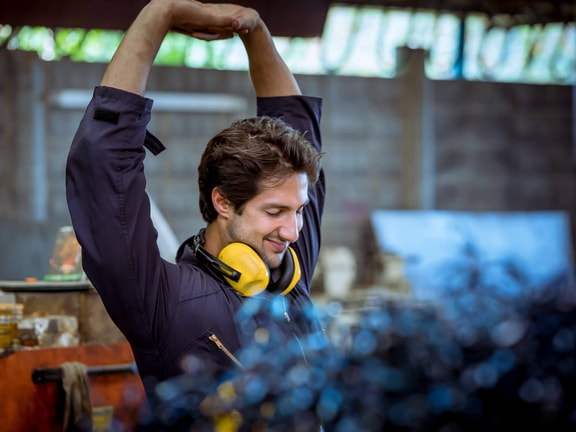
Musculoskeletal disorders remain one of the leading causes of disability and lost work time in industrial populations.¹ Many organizations now recognize these workers as industrial athletes, reflecting the physical demands placed on modern industrial roles.
Prolonged sitting, vibration exposure, repetitive lifting, awkward postures, and repetitive force create predictable biomechanical stress in many occupations.² When discomfort becomes normalized in the workplace, early tolerance decline often goes unmanaged until it escalates into a reportable injury.
For clinicians working in occupational settings, prevention cannot rely on general advice. It must follow the same principles that guide rehabilitation: screening, staged progression, recovery monitoring, and deliberate load management.
The question is not whether industrial injury prevention matters. It is how to implement it safely and effectively at scale.
What is an industrial athlete?
Industrial athletes are workers whose jobs require repeated physical performance under load—lifting, carrying, pushing, pulling, climbing, or sustaining demanding postures across long shifts. Much like traditional athletes, they rely on strength, endurance, coordination, and recovery capacity to perform safely.
Viewing workers as industrial athletes reframes injury prevention. Instead of responding only after injury occurs, clinicians can proactively support capacity development, load tolerance, and recovery behaviors that allow individuals to perform safely over time.
Step 1: Identify who is appropriate for structured prevention
Not every worker with discomfort belongs in a prevention pathway.
Before initiating progressive programming, clinicians should screen for bowel or bladder dysfunction, bilateral or progressive neurological symptoms, severe or highly irritable pain interfering with sleep or basic function, and unstable neurological signs. These findings warrant further evaluation rather than immediate participation in prevention, however they should still be given access to patient education that applies to them.
Industrial athletes presenting with stable, low-to-moderate symptoms and early load intolerance are appropriate candidates for progressive capacity building. Intervening at this stage allows clinicians to address tolerance decline before capacity failure occurs.
Step 2: Recognize early risk indicators in industrial athletes
Clinicians in industrial settings should watch for subtle early signals of declining load tolerance. Increasing end-of-shift stiffness, soreness lasting longer than 24 to 48 hours, guarded lifting patterns, reduced vibration tolerance, slower recovery between shifts, and escalating fatigue often signal declining load tolerance and elevated musculoskeletal risk.3
These markers reflect declining load tolerance rather than structural pathology. Addressing them early allows clinicians to adjust the load, reinforce recovery behaviors, and prevent minor irritation from progressing to a reportable injury.
Step 3: Apply progressive load preparation
Effective industrial prevention mirrors rehabilitation. It begins with motor control and layers complexity only when recovery behavior supports advancement.
Establish baseline load readiness
Early-phase programming emphasizes controlled activation and movement rehearsal before full occupational demand.
A warm-up prepares the body for predictable occupational load by increasing circulation, restoring mobility, and improving neuromuscular readiness before repetitive or sustained work tasks.
Early preparation may include movements that restore mobility and prepare tissues for occupational loading. Examples include:
Shoulder rolls, which help restore upper thoracic mobility after prolonged steering or tool use
Alternating overhead reach, which counteracts sustained flexion and improves scapulothoracic motion before vibration or lifting exposure
Recovery must be equally intentional. Post-shift cool-downs restore mobility and support physiological down-regulation after cumulative loading. Examples include:
Standing quad stretch, which helps address anterior chain stiffness associated with prolonged seated hip flexion
Forward fold, which restores posterior chain mobility after repetitive loading
Progression is guided by recovery response, specifically next-day stiffness duration and 24- to 48-hour symptom trends, rather than arbitrary timelines. When recovery deteriorates, progression pauses.
Progressive phase: increasing complexity and capacity
As tolerance improves, movement preparation should gradually increase in complexity. Later phases introduce:
Greater dynamic range
Coordinated trunk–hip integration
Increased neuromuscular demand
Higher systemic engagement
These elements help industrial athletes tolerate the multidirectional and repetitive loads encountered during real job tasks. Warm-up routines become more dynamic to prepare the body for increasing occupational demands, while cool-down strategies continue to support mobility restoration and recovery following cumulative loading.
Progression should remain guided by recovery response rather than by timeline alone. If symptoms exceed baseline thresholds, recovery extends beyond 48 hours, or neurological signs emerge, regression or further evaluation may be warranted. In this phase, prevention requires the same clinical vigilance used in rehabilitation: monitoring tolerance, adjusting load exposure, and progressing only when recovery remains predictable.
Step 4: Integrate education as a clinical tool
Industrial prevention must reinforce movement behaviors and recovery habits that directly influence tissue tolerance. Optimizing lifting mechanics can reduce cumulative spinal load during repetitive occupational tasks.4 Education around early warning signs improves reporting before minor irritation becomes injury.2 Micro-break implementation interrupts sustained loading. Hydration, sleep, and stress regulation affect systemic recovery capacity.
When clinicians reinforce these behaviors alongside progressive movement preparation, they address both local tissue load and systemic recovery.
Without behavioral consistency between shifts, progression stalls. When patient education is embedded within staged progression, it reinforces behavior between shifts and strengthens carryover beyond the clinic visit.
Step 5: Monitor outcomes and adjust
If prevention is not measured, it is guesswork.
Clinicians should observe symptom trends across weeks rather than single sessions. Fatigue patterns and recovery duration often reveal more than peak performance. Perceived load tolerance provides insight into capacity development. When symptom trends worsen despite modification, escalation may be necessary.
Integrated tracking strengthens clinical judgment by making tolerance trends visible over time.
Putting structured prevention into practice
Implementing phased prevention across a workforce is clinically sound in theory. The challenge is delivering it consistently—across roles, shifts, and varying access—without losing oversight.
Medbridge’s Occupational Health Pathways (including injury prevention programs for drivers and equipment operators, mechanical and maintenance roles, production and material handlers, and desk workers) apply this phased model within an organized progression framework. Each track follows a six- to eight-phase progression, integrating role-specific warm-ups and cool-downs, targeted movement preparation, embedded education, and outcome tracking.
For clinicians, this replaces ad hoc programming with defined progression, built-in screening considerations, and ongoing visibility into symptom trends between visits.
This model changes the workflow. Instead of reacting after escalation, clinicians gain earlier insight into tolerance patterns. Conversations about mechanics, warning signs, and recovery are reinforced between shifts rather than repeated only during in-person sessions.
What care looks like in Pathways
Case example: Driver with emerging load intolerance
A 45-year-old equipment operator reports increasing end-of-shift lumbar stiffness and morning tightness that now lasts several hours. He denies neurological symptoms, constant pain, or red flag indicators. Symptoms remain intermittent but have gradually intensified over the past month.
Screening confirms declining load tolerance rather than acute pathology. He is appropriate for structured prevention rather than formal injury management.
He is enrolled in the Driver and Equipment Operator Injury Prevention Pathways program.
Early phase: Stabilizing recovery
The program begins with the Starter Warm-Up and Starter Cool-Down to support controlled activation before vibration exposure and mobility restoration after the shift. Progression is guided by recovery response, specifically next-day stiffness duration, and 24- to 48-hour symptom trends rather than by timeline alone.
Mid-phase progression: Expanding tolerance
As recovery stabilizes, movement preparation becomes more dynamic. Advancement occurs only when symptoms remain predictable, and recovery remains within expected thresholds.
Education reinforces the clinical goals of this stage. Modules such as “What is a neutral spine, and why should it matter to me?” and “Avoid that OSHA reportable. Early warning signs of injury.” connect movement preparation to safer performance and earlier reporting. Recovery lessons like “Give me a (micro) break” reinforce sustainable load tolerance across shifts.
Rather than repeating these conversations during every visit, clinicians can reinforce them consistently between encounters, supporting carryover, accountability, and earlier intervention when tolerance begins to decline.
Later phases: Building resilience and capacity
In later stages, the Progressive Warm-Up and Progressive Cool-Down routines increase neuromuscular demand and systemic engagement to reflect higher occupational load. If recovery remains stable, complexity advances. If stiffness escalates or recovery extends beyond expected limits, progression pauses.
Throughout the program, the clinician maintains visibility through the Medbridge platform by monitoring adherence, reviewing symptom trends, and adjusting progression between visits. Instead of waiting for a reportable injury, clinicians can intervene earlier and guide capacity development with objective insight.
Prevention as early clinical intervention
Industrial injury prevention is not a separate skill set from rehabilitation. For many industrial athletes, it is rehabilitation applied earlier in the load continuum.
When clinicians identify declining tolerance before structural breakdown, guide progression based on recovery response, and reinforce movement and recovery behaviors between shifts, care shifts from reactive injury management to proactive capacity building.
Phased programming, integrated education, and longitudinal symptom visibility do more than reduce discomfort. They give clinicians earlier insight into workload trends, create measurable markers of capacity, and support safer workforce participation.
Prevention becomes most effective when it is treated as an ongoing clinical process, not a one-time initiative or checklist.
Industrial athletes do not need more generic advice. They need earlier guidance, clearer progression, and consistent clinical oversight.
References
Prall, J., & Ross, M. (2019). The management of work-related musculoskeletal injuries in an occupational health setting: The role of the physical therapist. Journal of Exercise Rehabilitation, 15(2), 193–199. https://pmc.ncbi.nlm.nih.gov/articles/PMC6509454/
Occupational Safety and Health Administration. (n.d.). Ergonomics. U.S. Department of Labor. https://www.osha.gov/ergonomics
Schmidt, K. G., Holtermann, A., Jørgensen, M. B., Svendsen, M. J., & Rasmussen, C. D. N. (2021). Developing a practice and evidence-based guideline for occupational health and safety professionals to prevent and handle musculoskeletal pain in workplaces. Applied Ergonomics, 97, 103520. https://www.sciencedirect.com/science/article/pii/S0003687021001678
Kuijer, P. P., Verbeek, J. H., Visser, B., Elders, L. A., Van Roden, N., Van den Wittenboer, M. E., Lebbink, M., Burdorf, A., & Hulshof, C. T. (2014). An evidence-based multidisciplinary practice guideline to reduce the workload due to lifting for preventing work-related low back pain. Annals of Occupational and Environmental Medicine, 26, 16. https://pmc.ncbi.nlm.nih.gov/articles/PMC4081511/
Meet the Author


Subscribe to Our Newsletter
Related Posts

March 2, 2026
Medbridge Debuts MSK Solutions for the Industrial Athlete
By Medbridge

August 20, 2025
Evidence-Based Fall Prevention for Older Adults: From Screening to Strength
By Medbridge

July 2, 2026
Prevention Without Context: Why Injuries Persist in High-Performance Sport
By Victor Jiménez Aransay

March 25, 2026
When Protocols Aren’t Enough: Making High-Stakes Return-to-Sport Decisions for Elite Athletes
By Victor Jiménez Aransay