
Written Language Production in Aphasia: Agraphia Assessment
Presented by Brett McCardel
This course presents a comprehensive framework for assessing agraphia in individuals with aphasia, emphasizing how acquired impairments in written language can affect communication, independence, and quality of life. Participants will learn to apply a cognitive neuropsychological model of writing to identify specific subtypes of agraphia and plan targeted, person-centered assessments at the single-word, sentence, and discourse levels. The course also explores the importance of distinguishing between language- and motor-based writing impairments and discusses collaboration with occupational therapy when appropriate. With integration of the Life Participation Approach to Aphasia, clinicians will be equipped to align assessment strategies with each client’s real-world needs and goals. This course is relevant for speech-language pathologists working across clinical settings, particularly those involved in adult neurorehabilitation.
Learning Objectives
- Examine agraphia and how acquired written language impairments can impact the quality of life for people with aphasia
- Analyze how impairments in specific components of a cognitive neuropsychological model of written language may impact writing and spelling abilities
- Plan for an agraphia assessment that examines written language abilities at the single-word, sentence, and paragraph/discourse levels
- Integrate agraphia assessment approaches utilizing the Life Participation Approach to Aphasia framework
Meet your instructor

Brett McCardel
Brett McCardel is the owner and founder of Archways—Aphasia Rehabilitation Services, a private practice that specializes in providing speech and language services to people with aphasia. He has worked with people with aphasia across the continuum of care and across a variety of service-delivery models (including telehealth…
Chapters & learning objectives

1. Introduction to Agraphia
The first chapter of this course defines agraphia, outlines its neurological underpinnings, and distinguishes between central and peripheral subtypes based on the cognitive and motor processes involved in writing.

2. A Cognitive Neuropsychological Model of Written Language Production
This chapter describes impairments in the linguistic processes of spelling and word retrieval, including phonological, lexical, semantic, and syntactic errors characteristic of central agraphia subtypes.
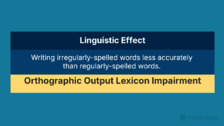
3. Agraphia Subtypes
This chapter explains impairments in motor programming, execution, and visuospatial aspects of writing, such as apraxic, spatial, and allographic agraphia.

4. Agraphia Assessment at the Single-Word Level
This chapter details structured and informal methods for evaluating agraphia, focusing on spelling, syntax, discourse, and functional writing skills.
5. Agraphia Assessment at the Sentence and Paragraph/Discourse Levels
This chapter reviews widely used formal tools for diagnosing and quantifying agraphia, including their purposes, strengths, and limitations.
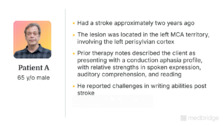
6. Agraphia Assessment Utilizing a Life Participation Approach to Aphasia
The final chapter of this course presents flexible, clinician-designed strategies for assessing real-world writing abilities, personalized to client needs and contexts.
Frequently asked questions
Everything you need to know about Medbridge courses.
Who creates Medbridge courses?
We work with industry-leaders, top researchers, and consultants to build content roadmaps that are then structured into courses, filmed, and edited by our production team before being launched to our site.
How often does Medbridge release new courses?
New courses are added monthly and are automatically included in your subscription as they launch.
How often does Medbridge update courses?
Medbridge reviews its courses annually for relevance and to assess if content is up to date. Based on these reviews it may be determined that a course is out of date resulting in the course being re-filmed or retired, if the content is no longer needed (e.g. a replacement course already exists, the concepts are no longer best practice, etc.).
How many courses does Medbridge offer?
We have over 3,000 accredited courses and we are continually updating our library with new courses. Check our course library for the most up-to-date count for your discipline.
Are there any additional fees for taking a Medbridge course?
There are no additional fees for taking a Medbridge course, obtaining a course certificate of completion, earning CEUs as a subscriber, or accessing any of the additional tools your subscription may include.
Is there a limit to the number of courses I can take?
There is no limit to the number of courses you can take as a subscriber! As a subscriber to Medbridge, you have unlimited access to over 3,000+ accredited CE courses.
If you are a Premium subscriber, you also have unlimited access to our Patient Engagement Tools such as the Home Exercise Program, Patient Education Library, Orthopedic Exam Tests, and Manual Therapy Techniques. We have over 7,000 exercises and over 650+ videos and handouts of patient education resources with more exercises and patient education added to the library based on subscriber feedback, volume of request and specialities.
What is your refund policy?
You are eligible for a refund provided your request is received within 30 days of your subscription purchase and your account has no activity.