
Recognizing Cervicogenic Headache in Physical Therapy: Clinical Clues and Treatment Strategies
Cervicogenic headache can be challenging to recognize when symptoms overlap with migraine or other headache disorders. For physical therapists, it requires integrating the patient's history, symptom behavior, physical examination, functional limitations, and response to movement and treatment.
September 9, 2026
8 min. read
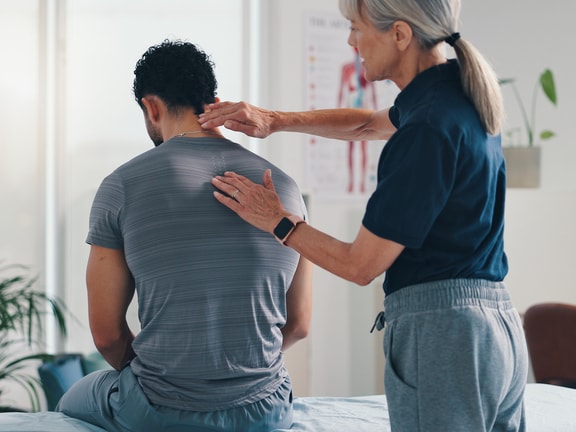
Headache is a common and often complex complaint in outpatient physical therapy. While many patients with recurrent headaches are diagnosed with migraine or tension-type headache, some presentations may involve musculoskeletal contributions from the cervical spine. For physical therapists, recognizing this pattern is an important part of clinical reasoning because patients with cervicogenic headache may benefit from targeted rehabilitation.
Cervicogenic headache (CGH) is a secondary headache disorder in which pain is referred to the head from structures of the cervical spine. Its presentation can overlap with other headache disorders, making recognition challenging. A careful history, cervical examination, and functional assessment can help clinicians determine whether cervical impairments may be contributing to a patient's symptoms.1
Clinical Clues That May Suggest Cervicogenic Headache
No single symptom or examination finding confirms cervicogenic headache. Instead, clinicians should consider the overall pattern of the patient's history and examination.
Clinical clues that may suggest a cervical contribution include:
Headache that is predominantly unilateral
Neck pain or stiffness accompanying the headache
Reduced cervical range of motion
Familiar headache symptoms reproduced with cervical movement or sustained postures
Symptoms aggravated by desk work, driving, reading, or other prolonged positions
Tenderness or mobility restrictions in the upper cervical or cervicoscapular region
Impaired deep neck flexor control or endurance
Reduced scapular strength or cervicoscapular endurance
These findings should be interpreted together with the patient's symptom behavior, functional limitations, and response to movement or examination.1
A Short Differential-Diagnosis Check
Cervicogenic headache can resemble migraine and tension-type headache, and some patients may experience overlapping features.
Migraine may involve nausea, sensitivity to light or sound, and moderate-to-severe throbbing or pulsating pain. Tension-type headache is often bilateral and may present as a pressing or tightening sensation. However, these characteristics are not always clear-cut, so clinicians should avoid relying on a single symptom to differentiate headache types.2
Physical therapists should also screen for potential secondary headache disorders and other medical red flags. Concerning findings can include a sudden or unusually severe headache, new neurological symptoms, fever, recent trauma, unexplained weight loss, or a significant change in a patient's established headache pattern. When findings raise concern for a medical cause, appropriate referral for further evaluation is warranted.3
Case Example: Chronic Headache With a Cervical Contribution
A 32-year-old woman who worked full-time at a computer presented with a five-year history of right-sided headaches accompanied by neck pain. Her symptoms had progressively worsened and had become constant during the eight weeks before beginning physical therapy.
She had previously been treated for migraine, but medication and supplements had not provided meaningful relief. A brain MRI was normal. Cervical imaging showed degenerative findings, but these findings were considered in the context of the patient's history and physical examination rather than assumed to be the direct cause of her symptoms.1
The patient's pain began in her neck and radiated into the right frontal and temporal regions. Symptoms increased with neck movement and prolonged computer work.
At the initial evaluation, she reported headaches seven days per week, with an average intensity of 8/10. Her Neck Disability Index (NDI) score was 54%, indicating substantial functional impact.
Key Examination Findings
The physical examination revealed limited cervical motion, postural and scapular control deficits, and reproduction of familiar headache symptoms during upper cervical testing.
The cervical flexion-rotation test (FRT) was positive. The test places the cervical spine in full flexion before assessing rotation, with the movement primarily intended to assess upper cervical rotation, particularly at C1-C2. Limited right rotation accompanied by reproduction of the patient's familiar symptoms supported the clinical impression of a cervical contribution. However, the test should be interpreted as one component of the overall examination rather than used independently to establish the diagnosis.4
The craniocervical flexion test was also positive. This low-load assessment evaluates activation and endurance of the deep cervical flexor muscles, which contribute to cervical control and postural support. Using pressure biofeedback, the patient was unable to maintain pressure beyond 22 mmHg without compensatory activation of the superficial neck muscles.5
Together, these findings helped identify impairments that could be addressed through rehabilitation.
A Clear Treatment Decision Pathway
Treatment should be individualized based on symptom irritability, examination findings, functional limitations, patient goals, and response to intervention.
A practical treatment progression may include:5,6
Reduce symptom irritability and improve tolerance to movement.
Restore cervical and thoracic mobility when mobility restrictions are identified.
Retrain deep cervical flexor motor control and endurance.
Improve scapular strength and cervicoscapular control, including coordinated movement between the cervical and scapular regions.
Address sustained postures and movement habits, including workstation setup and other activities that aggravate symptoms.
Progress toward independent exercise and long-term self-management.
The goal is not simply to treat the neck. Rather, rehabilitation should address the impairments and functional behaviors that may be contributing to the patient's headache experience.
Treatment Strategy
The patient participated in a 12-week multimodal physical therapy program, combining several complementary interventions rather than relying on a single treatment approach.5,6
Manual Therapy
Manual therapy addressed cervical and thoracic mobility restrictions and soft-tissue sensitivity. It was used to help reduce symptom irritability and improve tolerance for active rehabilitation rather than serving as a stand-alone intervention.6
Therapeutic Exercise
Exercise initially focused on graded craniocervical flexion using pressure biofeedback. As motor control improved, the program progressed to scapular retraction, serratus anterior activation, and middle and lower trapezius strengthening.
Exercises progressed from low-load motor control to resisted strengthening as tolerated, with progression guided by the patient's symptoms and functional response.5,6
Education and Self-Management
Education focused on workstation setup, avoiding prolonged cervical positions, taking regular movement breaks, and improving cervical and scapular awareness during activities such as driving, cooking, lifting, and desk work.
Rather than encouraging patients to avoid movement altogether, education emphasized modifying aggravating positions and building sustainable movement habits that could support long-term self-management.1,5
Monitoring Progress
Progress was monitored using a headache diary, the Numeric Pain Rating Scale, and the Neck Disability Index.
At six weeks:
Headache frequency decreased from 7 to 3 days per week
Average headache intensity decreased from 8/10 to 4/10
At 12 weeks:
Headache frequency decreased to 1 day per week
Average intensity decreased to 2/10
NDI improved from 54% to 10%
The patient also reported improved sleep and greater tolerance for computer work and daily activities.
While a single case cannot establish treatment effectiveness, these changes illustrate the types of symptom and functional outcomes clinicians can monitor when developing an individualized rehabilitation plan.
Clinical Takeaways
Consider a cervical contribution when headache symptoms are associated with neck pain, restricted cervical motion, sustained postures, or reproduction of familiar symptoms during cervical examination. 1,4
Use a combination of history and examination findings rather than relying on a single test or imaging finding. 1,4
Screen for other headache types and medical red flags and refer when findings warrant further medical evaluation. 2,3
Match treatment to the patient's impairments, functional needs, and response to care. 1,6
Consider a multimodal approach that may include mobility interventions, motor-control exercises, scapular strengthening, education, and a home exercise program. 5,6
Measure both symptoms and function to determine whether treatment is making a meaningful difference in the patient's daily life.
Ready to Learn More?
Want to take a deeper dive into the examination and management of cervicogenic headache?
Management of the Cervicogenic Headache, presented by Cheryl Sparks, reviews headache classification, screening and referral, physical examination, clinical interpretation, and evidence-informed intervention strategies. The course is designed to help physical therapists develop a systematic approach to evaluating and managing patients with headaches.
Cervicogenic headache can be challenging to recognize when symptoms overlap with migraine or other headache disorders. For physical therapists, identifying a potential cervical contribution requires more than finding a single positive test or an abnormality on imaging. It requires integrating the patient's history, symptom behavior, physical examination, functional limitations, and response to movement and treatment.1,4
This case illustrates how an individualized, multimodal rehabilitation program can address cervical and cervicoscapular impairments while also incorporating education and self-management strategies. By looking beyond the headache itself and considering how cervical impairments affect movement and daily activities, physical therapists can develop a more comprehensive approach to care.
References
Fahmy K, Chang E, Adams C. Cervicogenic headache. Phys Med Rehabil Clin N Am. 2025;36(4):763-780. doi:10.1016/j.pmr.2025.07.004.
Headache Classification Committee of the International Headache Society (IHS). The International Classification of Headache Disorders, 3rd edition. Cephalalgia. 2018;38(1):1-211. doi:10.1177/0333102417738202.
Do TP, Remmers A, Schytz HW, et al. Red and orange flags for secondary headaches in clinical practice: SNNOOP10 list. Neurology. 2019;92(3):134-144. doi:10.1212/WNL.0000000000006697.
Ogince M, Hall T, Robinson K, Blackmore AM. The diagnostic validity of the cervical flexion-rotation test in C1/2-related cervicogenic headache. Man Ther. 2007;12(3):256-262. doi:10.1016/j.math.2006.06.016.
Jull G, Trott P, Potter H, et al. A randomized controlled trial of exercise and manipulative therapy for cervicogenic headache. Spine (Phila Pa 1976). 2002;27(17):1835-1843. doi:10.1097/00007632-200209010-00004.
Bini P, Hohenschurz-Schmidt D, Masullo V, Pitt D, Draper-Rodi J. The effectiveness of manual and exercise therapy on headache intensity and frequency among patients with cervicogenic headache: a systematic review and meta-analysis. Chiropr Man Ther. 2022;30:49. doi:10.1186/s12998-022-00459-9.
Meet the Author
.jpg)

Subscribe to Our Newsletter
Related Posts
January 11, 2017
Neck Pain Best Practice: Treatment-Based Classification
By John Snyder
July 23, 2025
Concussion Management Strategies: Early Assessment, Subtypes, and Treatment
By Medbridge

April 6, 2026
Neck Disability Index (NDI): How to Score It and Use It to Track Meaningful Patient Progress
By Carole Spradling and Medbridge
August 27, 2024
Download a Cervical Radiculopathy Physical Therapy Exercises PDF
By Medbridge