
Strength Training in Children: When Can They Start and How Can It Be Done Safely?
Is your child too young to start strength training? Current research and leading pediatric organizations say no, as long as it's done the right way. Here's what parents should know about introducing strength training safely, from the myth that it stunts growth to why technique should always come before load.
October 7, 2026
8 min. read
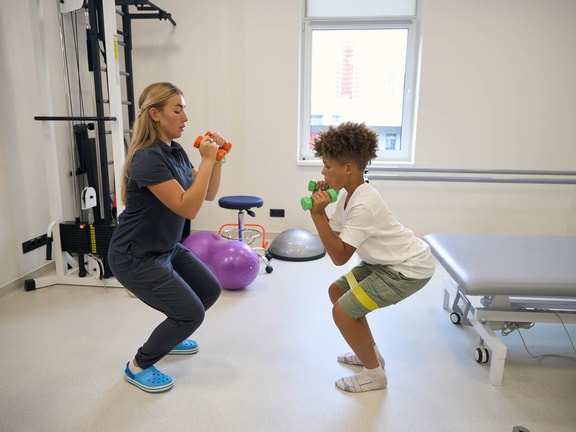
A parent watches his eight year old child performing a weighted squat and immediately asks: “Isn’t he too young to be doing strength training?”
It is an understandable concern. For decades, we have heard that lifting weights during childhood could stunt growth, damage the growth plates, or cause injuries.
But is it too early to teach a child how to become stronger and move properly?
Current evidence indicates that a well-designed strength training program can be both safe and beneficial during childhood and adolescence. The American Academy of Pediatrics (AAP), the National Strength and Conditioning Association (NSCA), and a 2014 international consensus statement all support its use, provided that the training is appropriately adapted to the child’s developmental stage and individual abilities.1,2,3
Therefore, the question should not simply be when children can begin strength training, but rather how it should be introduced.
There Is No Exact Age
When I talk to parents about this topic, one of the first questions I usually hear is: “But at what age can they start?”
There is no magic age. Some eight year olds are able to follow instructions and control certain movements much better than other children who are 10 or 11. That is why, in addition to age, we should consider maturity, coordination, the ability to follow instructions, and previous experience with exercise.
The NSCA states that if a child is ready to participate in organized sports, they are generally also ready to begin some form of strength training.2 And this is where one of the main misconceptions appears: strength training does not necessarily mean lifting a heavy barbell.
Squatting, climbing, pushing, pulling, jumping, landing, or carrying an object are all different ways of producing force. In fact, children do these things long before they ever set foot in a gym. We only have to watch them playing in a park.
The difference is that when we introduce structured training, we can teach these movements and control the level of difficulty much more carefully.
The Myth That Strength Training Stunts Growth
This is probably the concern most commonly associated with strength training in children: “Lifting weights can stunt their growth.”
However, the available evidence does not support this claim when we are talking about appropriately designed training programs.1,2 Injury rates reported in supervised environments are also low.1,4
That does not mean that injuries cannot occur. Injuries can also happen while playing soccer, running, or jumping.
What is important is understanding where the problem usually comes from. In youth strength training, many of the injuries that have been reported are associated with accidents, improper use of equipment, inappropriate loads, or inadequate supervision.4
Therefore, the problem is usually not strength training itself, but rather asking a child to do something they are not yet prepared to do.
Children Can Become Stronger Without Developing Large Muscles
This is another aspect that often surprises people when we talk about strength training during childhood.
A child can become considerably stronger without developing large muscles. During the prepubertal years, many of the initial improvements in strength are explained by neuromuscular adaptations. Put simply, the nervous system learns how to use the muscles the child already has more effectively, improving coordination and the ability to produce force.1,3
That is why, when we introduce strength training to a child, the initial goal should not be to build large muscles or continually lift heavier weights. The priority should be teaching the child how to use their body effectively.
Technique Before Load
This is probably the principle I use most often when working with children: learn first, load later.
Before worrying about how much weight a child can lift, I want to see how they move. A squat, a hip hinge, pushing, pulling, jumping, landing, or stabilizing the trunk can tell us much more in the beginning than knowing how many kilograms they can lift.
For that reason, I usually begin with simple exercises using body weight, resistance bands, lightweight medicine balls, or small external loads. As the child develops better control of the movement, we can gradually increase the difficulty.1,3
And again, there is no need to overcomplicate things. Two 10 year old children may have completely different abilities. One may be ready to add external load, while the other may need more time practicing the same movement.
Age can provide some guidance, but movement quality tells us when it is appropriate to progress.
Strength Training or Play? Both
Another mistake is assuming that once a child starts strength training, they need to spend several hours each week inside a gym.
That should not be the case. During childhood, children need exposure to many different types of physical stimuli. Playing and participating in different sports are also fundamental for developing a broad physical foundation. Strength training should complement these activities, not replace them.
In fact, international physical activity guidelines for children and adolescents include muscle- and bone-strengthening activities as part of an active lifestyle.5
And especially with younger children, there is something we should never lose sight of: they need to enjoy it. We may design the best training program possible on paper, but if we make a nine year old begin to view exercise as an obligation, we have probably lost a very important part of the objective.
Are There Any Children Who Should Not Do Strength Training?
Rather than talking about children who “cannot” perform strength training, in many situations I think it is more appropriate to talk about how that training should be adapted.
An injury, pain, or certain cardiovascular, neurological, or musculoskeletal conditions should prompt a medical evaluation before beginning. Some medical conditions may rule out resistance training, but a limitation does not automatically mean that all strength training should be eliminated.1,2
Sometimes, adapting the training can be as simple as changing an exercise, reducing the load, modifying the range of motion, or selecting a different task.
That is why, when working with a child who has a particular limitation, I prefer not to ask only: “Can this child do strength training?”
The question that interests me more is: “What can this child do today, and how can I adapt it so they can do it safely?” It may seem like a small change in the way we approach the situation, but it can completely change how we understand exercise.
How Would I Start?
If I had to simplify everything above for parents who want their child to begin strength training, I would summarize it in four steps. Whatever the starting point, children should learn and progress under the supervision of a qualified professional, especially once external resistance or equipment is involved.2,4
1. Learn how to move.
Start with simple movements and teach the child how to control their own body.
2. Master the movement before increasing the difficulty.
If the child still cannot control a movement properly, adding more weight should not be the solution.
3. Progress gradually.
Once an exercise can be performed correctly, we can gradually increase the resistance, training volume, or level of difficulty. There is no need to constantly take a child to muscular failure or turn every training session into a test of maximal strength.
4. Remember that they are still children.
Strength exercises, running, jumping, throwing, balance activities, and games can all be part of the same session. The greater the variety of movements children experience, the broader the physical foundation we are helping them develop.
Conclusion
Childhood is a particularly important stage for learning how to move.
And precisely for that reason, I believe we should take advantage of this period to expose children to many different movement experiences. Strength training can be one of them, but it should not be the only one.
Running, jumping, throwing, climbing, changing direction, and participating in different sports can also help children develop coordination and a broader foundation of motor skills.6
Ultimately, the goal is not to create young specialists or children who become obsessed with how much weight they can lift.
The goal is something much simpler: to help children become strong, coordinated, capable of adapting to different physical situations and, above all, to enjoy moving.
If we can achieve that, we may be accomplishing something even more important than simply making them stronger today: helping them build a positive relationship with exercise that can stay with them for many years.
References
1. Stricker, P. R., Faigenbaum, A. D., McCambridge, T. M., & Council on Sports Medicine and Fitness. (2020). Resistance training for children and adolescents. Pediatrics, 145(6), e20201011.
2. Faigenbaum, A. D., Kraemer, W. J., Blimkie, C. J. R., et al. (2009). Youth resistance training: Updated position statement paper from the National Strength and Conditioning Association. Journal of Strength and Conditioning Research, 23(5 Suppl), S60–S79.
3. Lloyd, R. S., Faigenbaum, A. D., Stone, M. H., et al. (2014). Position statement on youth resistance training: The 2014 International Consensus. British Journal of Sports Medicine, 48(7), 498–505.
4. Faigenbaum, A. D., & Myer, G. D. (2010). Resistance training among young athletes: Safety, efficacy and injury prevention effects. British Journal of Sports Medicine, 44(1), 56–63.
5. World Health Organization. (2020). WHO guidelines on physical activity and sedentary behaviour. World Health Organization.
6. McDonough, D. J., Liu, W., & Gao, Z. (2020). Effects of physical activity on children’s motor skill development: A systematic review of randomized controlled trials. BioMed Research International, 2020, 8160756.
Meet the Authors



Subscribe to Our Newsletter
Related Posts

December 27, 2021
6 Strategies for Keeping Children Engaged During Virtual Speech and Language Sessions
By Julie Sovinsky

February 2, 2022
Rethinking the Importance of Skill Training for Dysphagia
By Tiffani L. Wallace

August 16, 2017
Rotator Cuff Injury Assessment & Suggested HEP
By Lenny Macrina

February 9, 2021
Overcoming Bullying of Children Who Stutter: How SLPs Can Help Parents
By J. Scott Yaruss