
Success Story: Healing a Stage III Pressure Ulcer in Advanced Dementia through Interdisciplinary PT Innovation
Caring for patients with advanced dementia requires creativity, collaboration, and clinical flexibility. This success story shows how interdisciplinary physical therapy helped achieve meaningful pressure ulcer healing when conventional approaches stalled.
January 30, 2026
5 min. read
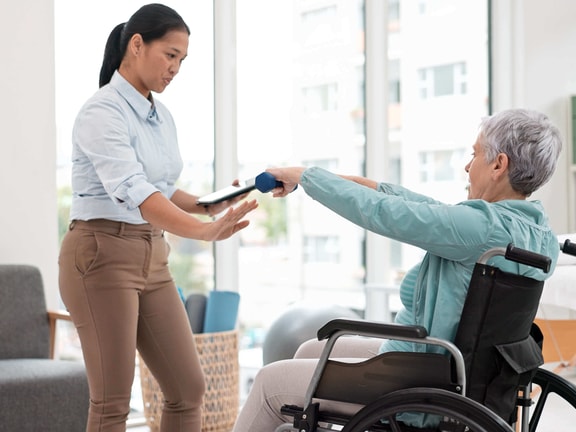
In the memory care unit of a skilled nursing facility in Sacramento, I encountered a patient whose complex medical and cognitive needs challenged each aspect of conventional rehabilitation. What unfolded became one of the most meaningful clinical experiences of my career and a testament to the power of creative problem-solving in physical therapist practice.
The issue
I was referred an 80-year-old woman with advanced Alzheimer’s disease who had been living in this skilled nursing facility for four years. She was largely nonverbal, oriented only to herself, and dependent on nursing staff for nearly all aspects of daily care. For five months, she had been battling a Stage III sacral pressure ulcer that showed minimal signs of healing despite consistent wound care. She presented with pain, impaired sitting balance, generalized weakness, and significant difficulty maintaining postural alignment.
Her inability to communicate discomfort meant that early signs of worsening pain or pressure were often missed. Traditional interventions had been attempted without significant progress. The challenge was clear: How could I support wound healing and improve her functional stability when her cognition, communication, and mobility were so profoundly limited?
The solution
As I considered her history and physical, I revisited the literature on pulsed shortwave diathermy (PSWD). While its use is still emerging in long-term care settings, evidence shows that PSWD can accelerate wound healing and promote improved tissue perfusion without generating harmful heat. For a patient who could not tolerate electrical stimulation and who struggled to follow instructions during treatment, PSWD offered a safe, noninvasive alternative.
I collaborated closely with the wound care physician, nursing team, and dietitian. With the responsible party’s consent, we initiated a four-week program consisting of 16 one-hour physical therapy sessions. Each session combined 30 minutes of subthermal PSWD followed by 30 minutes of therapeutic strengthening, seated balance activities, and functional training.
The nursing staff supported the plan by ensuring optimal pressure relief, adhering to repositioning schedules, and performing proper dressing changes. We provided postural education and trained the nursing staff in correct positioning techniques in bed and in her wheelchair. The patient was also provided with a ROHO cushion and a low air loss mattress to support offloading throughout the day.
Our interdisciplinary approach created a consistent environment to support healing that extended far beyond the treatment gym.
The outcome
By the end of the four-week program, the patient demonstrated results that exceeded expectations.
Her Stage III sacral ulcer, which had lingered for months, healed fully. Slough tissue resolved completely, exudate disappeared, and the wound fully closed with stable tissue and no signs of infection. For the first time in months, she was free of any pain, reflected in a PAINAD score of 0.
Her Braden score—a widely used tool for assessing pressure-injury risk—improved from 14 (moderate risk) to 18 (mild risk), reflecting gains in sensory response, moisture management, and mobility. Perhaps most meaningfully, her Function in Sitting Test (FIST) score more than doubled, improving from 22 to 46 out of 56. This reflected clear gains in postural control, dynamic stability, and comfort during seated activities.
Nursing staff reported that she was more relaxed, more upright in her wheelchair, and more engaged with her environment. Her ability to tolerate sitting for meals and engaging in social interactions improved significantly. This was a reminder that wound healing is not just about tissue recovery, but about restoring dignity and participation.
Lessons from practice
This case reinforced for me that physical therapists are problem solvers first. In long-term care, where patients face cognitive decline, limited mobility, and multiple co-morbidities, progress requires creativity, persistence, and strong collaboration. The success of this case was not due to one modality alone. It was the product of interdisciplinary teamwork, patient-centered innovation, and thoughtful clinical reasoning.
In dementia care, the smallest improvements can have an outsized impact. The healing of this ulcer restored comfort, improved safety, and allowed the patient to interact with her environment with greater ease. For a patient who could not speak for herself, these outcomes mattered deeply.
This experience also highlighted the potential role of PSWD as a valuable tool in wound management for cognitively impaired patients. The modality requires minimal patient participation, is safe when applied appropriately, and has evidence supporting its role in promoting tissue healing. While more research is needed, especially in populations with dementia, this case adds to a growing body of clinical evidence that PSWD can be an effective adjunct to standard wound care.
This case was also documented in a full case report published in The American Journal of Medical Science and Research, which provides additional clinical detail, outcome measures, and discussion of PSWD application in long-term dementia care. You can read the full case report here.
Perspectives from the care team
While the clinical results were meaningful, the most compelling evidence of change came from those who saw the patient every day. Nurses, caregivers, and family members observed improvements in comfort, posture, and presence that reflected the deeper impact of coordinated, compassionate care.
“Her wound had not changed for months, and then gradually during that four-week period we saw real healing. It was the most progress she had made in a long time. Thank you so much”.
— Wound care nurse
“We could see the difference every day. She was sitting taller, calmer, and much more comfortable. It changed the way she interacted with us.”
— Certified nursing assistant
“As a family member, seeing her finally free of pain and able to sit upright meant everything for me. I am so grateful for the care all of you provided.”
— Patient’s daughter
Meet the Author


Subscribe to Our Newsletter
Related Posts

November 5, 2025
Managing End-of-Year Surgical Volumes with Medbridge Pathways and One Care
By Medbridge
April 28, 2026
When Everything Feels Urgent: How OTs Decide What Matters Most in Progressive Neuro Home Care
By Krista Covell-Pierson

February 21, 2017
Solve the Puzzle: How to Assess Altered Cognition in Acute Care
By Teepa Snow

November 30, 2020
Thoracic Outlet Syndrome: Understanding Unusual Clinical Presentations
By Ann Porretto-Loehrke