
PROMIS: How the Assessment, CAT, and T-Scores Work
January 23, 2025
12 min. read

PROMIS, or the Patient-Reported Outcomes Measurement Information System, is a standardized system for measuring self-reported physical, mental, and social health. It includes domains such as physical function, pain interference, fatigue, anxiety, depression, and social participation. PROMIS measures can be administered through short forms or computer adaptive testing and are commonly reported as standardized T-scores.
Let's take a look at how the PROMIS tool works, the evidence behind the tool, and how it's been integrated into Pathways to enhance patient assessment and their overall experience.
What is PROMIS?
PROMIS, or the Patient-Reported Outcomes Measurement Information System, is a standardized system for measuring self-reported physical, mental, and social health. It includes a collection of validated measures covering health domains that can apply across diagnoses, conditions, and care settings.¹
Common PROMIS domains include:
Physical Function
Pain Interference
Fatigue
Anxiety
Depression
Sleep Disturbance
Ability to Participate in Social Roles and Activities
Because PROMIS measures broader health domains rather than focusing exclusively on one condition or body region, the scores can provide a standardized view of patient-reported health across different populations.
PROMIS measures may be administered through fixed questionnaires or through computer adaptive testing, commonly referred to as PROMIS CAT.
How does PROMIS CAT work?
PROMIS CAT uses computer adaptive testing to select questions based on a patient's previous responses. Instead of giving every patient the same complete set of questions, the assessment uses each answer to identify the next item that will provide the most useful information about the health domain being measured.
For example, a patient reporting substantial difficulty with physical activity may receive different Physical Function questions than someone reporting relatively few limitations.
This adaptive approach can reduce the number of questions required while still producing a standardized PROMIS score. PROMIS CAT is designed for digital administration and can be used to measure domains such as physical function, pain interference, and participation in social roles.
PROMIS Domains Used in Medbridge Pathways
Each musculoskeletal pathway includes PROMIS measures covering three areas closely associated with function, pain, and participation:
Physical Function: A patient's self-reported ability to perform physical activities, including activities of daily living and activities in the community.
Pain Interference: The degree to which pain affects physical, social, cognitive, emotional, and recreational activities.
Ability to Participate in Social Roles and Activities: A patient's self-reported ability to perform their usual social roles and activities.
Patients complete PROMIS CAT assessments at defined points so changes in these domains can be tracked over time.
Physical Function: A patient's self-reported capability to do functional activities, such as activities of daily living (ADLs) and activities in the community.
Pain Interference: A patients self-reported impact of pain on their social, cognitive, emotional, physical, and recreational activities.
Ability to Participate in Social Roles and Activities: A patients self-reported ability to perform their usual social roles and activities.
Patients will complete their PROMIS-CAT to help clinicians measure and monitor their progression, function, and pain as applicable.
The PROMIS Physical Function CAT selects the most relevant items from this bank, ensuring that each patient receives a tailored and meaningful set of questions.
How to interpret a PROMIS T-score
A PROMIS Physical Function T-score is a standardized score derived from a patient's responses.
PROMIS measures generally use a T-score metric with a mean of 50 and a standard deviation of 10 in the relevant reference population. For many adult PROMIS measures, that reference is the U.S. general population.⁴
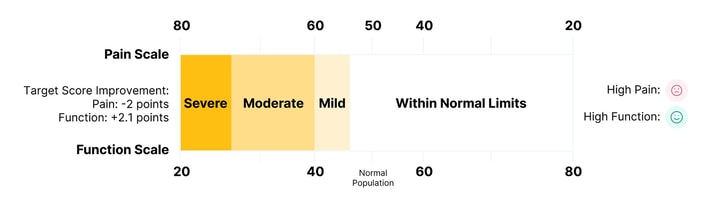
For example, for Physical Function:
A T-score of 50 represents the reference population mean.
A score above 50 represents greater self-reported physical function.
A score below 50 represents lower self-reported physical function.
A 10-point difference represents one standard deviation on the T-score scale.
A Physical Function T-score of 60 is one standard deviation above the reference mean, while a score of 40 is one standard deviation below it.
One rule is especially important when interpreting PROMIS scores:
A higher T-score means more of the concept being measured.⁴
For positively framed domains such as Physical Function, a higher score represents greater function.
For symptom-based domains such as Pain Interference, Fatigue, Anxiety, and Depression, a higher score represents more of that symptom or problem.
A higher score is therefore not automatically better or worse. The direction depends on the domain.
How to evaluate physical function and pain interference
Physical Function and Pain Interference are two of the most frequently reported PROMIS domains in orthopedic research. A systematic review found Physical Function in 81 percent of included orthopedic studies and Pain Interference in 61 percent.⁵
Looking at these domains together can provide more context than interpreting either score on its own.
Evaluating physical function
PROMIS Physical Function measures self-reported capability rather than observed physical performance.²
Questions may address activities such as walking, getting out of a chair, climbing stairs, carrying objects, completing household activities, or performing more demanding physical tasks.
A Physical Function score can be evaluated by considering several pieces of information:
Current status: Where the score falls relative to the reference population
Change from baseline: How the score has changed over the course of care
Functional goals: How the score relates to activities that matter to the patient
Other findings: How self-reported function compares to other aspects of assessement including strength, mobility, symptoms, and observed movement
For example, consider a Physical Function score that increases from 37 to 45.
The eight-point increase shows that the patient is reporting better function than at baseline. However, the follow-up score of 45 still falls below the reference population mean of 50.
Both pieces of information matter. The patient has improved, but some functional limitations may remain.
Evaluating pain interference
PROMIS Pain Interference measures how much pain affects participation in daily life rather than simply measuring pain intensity.
Questions may address how pain interferes with day-to-day activities, household responsibilities, social activities, recreational activities, and other tasks.⁶
Because higher PROMIS scores represent more of the measured concept, a higher Pain Interference score indicates that pain is having a greater impact on the patient’s daily life.
For Pain Interference:
A score above 50 generally represents more pain interference than the reference population mean.
A score below 50 represents less pain interference.
A decreasing score generally reflects movement in a favorable direction.
Consider a Pain Interference score that falls from 64 to 55.
The patient is reporting substantially less interference from pain than at baseline. However, the score remains above the reference population mean, suggesting that pain may still be affecting activities.
Pain intensity and Pain Interference should also be distinguished. A person may continue to experience a similar level of pain intensity while reporting that the pain interferes less with work, mobility, social activity, or recreation.
Evaluating the two domains together
Physical Function and Pain Interference often tell related but different parts of the story.
Consider these scores:
PROMIS domain | Baseline | Follow-up | Change |
Physical Function | 38 | 46 | +8 |
Pain Interference | 63 | 54 | -9 |
Physical Function increased, indicating greater reported ability to perform activities.
Pain Interference decreased, indicating that pain is disrupting those activities less.
Together, the results suggest improvement across both physical function and the effect pain has on daily life.
Different patterns are also possible.
A patient might report improved Physical Function while Pain Interference changes very little. That could indicate greater activity despite persistent pain.
Another patient might report substantially lower Pain Interference while Physical Function remains relatively stable. Pain may feel less disruptive, but other factors may still limit activity.
Reviewing both domains can help prevent one score from being treated as a complete representation of recovery.
What does a change in a PROMIS score mean?
Repeated PROMIS scores can help show how a patient's reported function or symptoms change over time.
For example, if a PROMIS Physical Function score increases from 38 to 46, the patient is reporting greater function. If a PROMIS Pain Interference score decreases from 63 to 55, pain is having less impact on daily activities.
The size of a score change should be interpreted in context. Research has found that estimates of meaningful change vary by PROMIS domain, condition, intervention, and patient population. Published thresholds should therefore be matched as closely as possible to the population and outcome being measured rather than applying one universal cutoff.³
This section gives the page stronger relevance for PROMIS score and PROMIS score interpretation without turning it into a separate scoring article.
Understanding Patient-Reported Experience Measures (PREMs)
While patient-reported outcomes (PROs) focus on what changes in a patient’s health status, patient-reported experience measures (PREMs) capture how care was experienced from the patient’s perspective. PREMs assess the quality of communication, coordination of care, accessibility, and the overall patient–provider relationship.
Together, PROs and PREMs offer a more complete view of care quality—outcomes tell clinicians what improved, while experience measures explain why those outcomes occurred. This dual approach aligns with national healthcare quality frameworks that increasingly emphasize both patient outcomes and patient experience as key indicators of value-based care.
The Evidence Behind PROMIS-CAT
PROMIS is highly researched and widely validated for a large variety of musculoskeletal conditions, offering significant evidence supporting its accuracy, validity, and reliability in assessing patient-reported outcomes. Substantial qualitative and quantitative evidence supports the validity of PROMIS measures. Highlighted excerpts from HealthMeasures includes:
Content Validity
Content validity is built into a test from the outset through the choice of appropriate items.1 The content validity of PROMIS measures beginning in the use of patient interviews and reviews by expert review panels.
Cross-Sectional Validity Evidence
Cella, et al., 2010, reported results of initial validation studies of 11 PROMIS item banks measuring components of self-reported physical, mental, and social health, along with a 10-item Global Health Scale. Liu, et al., 2010 evaluated the representativeness of the Internet panel that was used for initial calibration of the PROMIS item banks. Rothrock, et al., 2010 compared PROMIS scores across chronic condition variables (e.g., number of comorbidities, whether condition was disabling).
Responsiveness to Change
As a person's symptoms and function change over time, scores on PROMIS measures are expected to also change. Demonstrating responsiveness to change is done by assessing individuals over time. Often, effect sizes and standardized response means are calculated. There is evidence that PROMIS measures capture change over time in different clinical contexts (e.g., patients starting a new treatment for depression, patients with rheumatoid arthritis initiating a disease-modifying antirheumatic drug, patients with spinal disorders, and children with asthma).
Clinical Validity Evidence
In 2016, a series of articles was published in the Journal of Clinical Epidemiology that evaluated the function of different PROMIS measures across clinical contexts. The validity evidence presented in this series of papers was unique in that each paper evaluated a single PROMIS domain across multiple conditions in real-world clinical settings.
Comparison With Legacy Measures
PROMIS has been shown to have moderate to strong correlations with traditional measures commonly used in MSK care, like the Oswestry Disability Index (ODI) and Neck Disability Index (NDI) for patients with low back pain and neck pain, respectively.
Edelen, et al., also show that PROMIS-CAT (function, pain interference, pain intensity) reasonably predicts Oswestry Disability Index (ODI) and Roland Morris Disability Questionnaire (RMDQ) for patients with chronic low back pain.
Advantages of PROMIS-CAT Over Legacy Measures
PROMIS-CATs faster assessment, patient-friendly delivery, and similar validity to legacy measures make it a superior option for both patients and providers, allowing for better patient experience and higher compliance.
Why PROMIS-CAT Was Selected for Pathways
PROMIS-CAT was chosen as the primary screening tool for Pathways based on its flexibility, ability to quickly assess patient function, and its strong correlation with other common PROs. It has been fully integrated into Pathways, providing regular, automated assessments that track patient progress and outcomes.
This offers a streamlined patient experience with fewer but more targeted questions, which increases completion rates and enhances the quality of data collected. This reduces the burden on patients to complete a lengthy questionnaire that may ask questions that are not relevant to their condition.
The Benefits of Using PROMIS-CAT in Pathways
Efficiency: PROMIS-CAT significantly reduces the time required for PRO assessments compared to traditional methods, making it ideal for busy healthcare settings.
Accessibility and adaptability: The computer-adaptive nature of PROMIS ensures that assessments are customized to each patient, reducing patient fatigue and improving response accuracy.
Cost-effectiveness: PROMIS-CAT is a cost-effective solution that replaces multiple traditional PROs with a single, adaptable system.
As a member of Medbridge's Medical Advisory Board, I help provide guidance on utilization of PRO assessments, which ultimately lead Medbridge to adopting the PROMIS-CAT and incorporating it into their Pathways. PROMIS-CAT is a highly researched, widely validated outcome measurement system leveraged across the healthcare industry. Because these outcomes are optimized for digital delivery, they are significantly shorter than traditional, static outcome measures and work well with the cutting-edge, validated tools in Pathways, enhancing patient care and clinical outcomes. Learn more about how Pathways helps providers manage their patients MSK and joint pain with targeted hybrid care that helps patients move better, feel better, and live better or request a demo to see Pathways in action.
Integrating PREMs with PROMIS in Pathways
Within Pathways, Medbridge integrates both patient-reported outcomes and patient-reported experience measures to capture the full continuum of patient feedback. PROMIS-CAT provides quantitative insight into physical function and pain, while embedded experience questions gather patient-reported experience data—covering satisfaction with communication, ease of use, and perceived care coordination.
This integration helps healthcare organizations evaluate both clinical progress and experience quality, supporting a more patient-centered model of musculoskeletal (MSK) care. Over time, combining PROs and PREMs allows organizations to identify patterns between patient satisfaction, engagement, and measurable outcomes.
As digital and hybrid care models become more common, patient-reported experience measures are essential to maintaining human-centered care. In digital MSK programs like Pathways, PREMs help providers evaluate usability, communication, and patient confidence in remote and in-person interactions. Tracking both PROMIS outcomes and experience metrics ensures the technology enhances—not replaces—the therapeutic relationship, supporting better adherence and overall satisfaction.
Meet the Author


Subscribe to Our Newsletter
Related Posts

May 20, 2025
Rotator Cuff Tendinopathy: Clinical Best Practices for Outpatient Rehabilitation
By Medbridge

June 2, 2026
Numeric Pain Rating Scale: How to Use It, Score It, and Track Pain Over Time
By Carole Spradling and Medbridge

August 27, 2024
Addressing Chronic Pain: A New Pathway to Better Patient Management and Hybrid Care
By Medbridge

May 7, 2026
American Shoulder and Elbow Surgeons (ASES) Score: What It Measures and How to Use It
By Carole Spradling and Medbridge