
Evidence-Based Clinical Considerations in Pediatric TBI: Treatment
Presented by Angela Ciccia
Treatment of cognitive-communication disorders following pediatric traumatic brain injury (TBI) requires a nuanced understanding of how injury severity, developmental stage, and care setting intersect. This course outlines evidence-based treatment approaches for attention, memory, executive function, and social communication impairments in children and adolescents with TBI. Emphasizing individualized, functional, and family-centered care, the course explores how interventions can be tailored across hospital, rehabilitation, and school environments. Speech-language pathologists and other rehabilitation professionals will gain practical strategies for addressing persistent postconcussion symptoms, supporting school reintegration, and promoting long-term recovery across developmental stages.
Learning Objectives
- Examine current trends in the treatment of cognitive-communication disorders in pediatric TBI
- Choose evidence-based treatment approaches for common cognitive-communication impairments (e.g., attention, memory, executive function, and social communication) in children and adolescents with TBI
- Select and apply intervention strategies that are developmentally appropriate and responsive to the unique needs of pediatric TBI across recovery stages
- Modify treatment focus based on service provision setting (e.g., medical, educational) for youth with pediatric TBI
Meet your instructor

Angela Ciccia
Angela Hein Ciccia is a professor in the Department of Psychological Sciences at Case Western Reserve University. Dr. Ciccia’s research focuses on factors that impact children’s ability to recover/develop in the presence of a diagnosis of an acquired (new-onset) and/or developmental neurogenic communication disorder. Dr.…
Chapters & learning objectives
1. Introduction
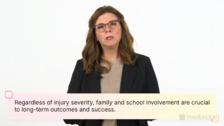
This chapter introduces the foundational principles of treating cognitive-communication challenges in children with TBI. It highlights the importance of early, multidisciplinary, and family- and school-centered intervention, even for mild injuries with lingering symptoms. Clinicians are also introduced to evolving trends in care, including the use of teletherapy and increased guideline-driven treatment options.
2. Current Evidence-Based Treatment Strategies
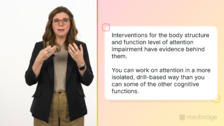
This chapter presents established treatment methods for attention, memory, executive function, and social communication, emphasizing functional and developmentally appropriate strategies. The role of metacognitive training, environmental supports, and generalization to real-life tasks is explored. Clinicians will also learn how to integrate restorative and compensatory approaches based on individual needs.

3. Modifications of Treatment Approaches
In this chapter, treatment adaptations are examined based on injury severity, care setting (hospital, rehabilitation, school), and developmental considerations. Specific strategies are provided for managing mild, moderate, and severe TBI across the recovery timeline. The importance of aligning intervention methods with the child’s cognitive readiness and environmental context is emphasized to optimize recovery and participation.
Frequently asked questions
Everything you need to know about Medbridge courses.
Who creates Medbridge courses?
We work with industry-leaders, top researchers, and consultants to build content roadmaps that are then structured into courses, filmed, and edited by our production team before being launched to our site.
How often does Medbridge release new courses?
New courses are added monthly and are automatically included in your subscription as they launch.
How often does Medbridge update courses?
Medbridge reviews its courses annually for relevance and to assess if content is up to date. Based on these reviews it may be determined that a course is out of date resulting in the course being re-filmed or retired, if the content is no longer needed (e.g. a replacement course already exists, the concepts are no longer best practice, etc.).
How many courses does Medbridge offer?
We have over 3,000 accredited courses and we are continually updating our library with new courses. Check our course library for the most up-to-date count for your discipline.
Are there any additional fees for taking a Medbridge course?
There are no additional fees for taking a Medbridge course, obtaining a course certificate of completion, earning CEUs as a subscriber, or accessing any of the additional tools your subscription may include.
Is there a limit to the number of courses I can take?
There is no limit to the number of courses you can take as a subscriber! As a subscriber to Medbridge, you have unlimited access to over 3,000+ accredited CE courses.
If you are a Premium subscriber, you also have unlimited access to our Patient Engagement Tools such as the Home Exercise Program, Patient Education Library, Orthopedic Exam Tests, and Manual Therapy Techniques. We have over 7,000 exercises and over 650+ videos and handouts of patient education resources with more exercises and patient education added to the library based on subscriber feedback, volume of request and specialities.
What is your refund policy?
You are eligible for a refund provided your request is received within 30 days of your subscription purchase and your account has no activity.