
Evidence-Based Clinical Considerations in Pediatric TBI: Assessment
Presented by Angela Ciccia
Pediatric traumatic brain injury (TBI) is a leading cause of acquired disability, impacting cognitive, behavioral, emotional, and communicative development. This course provides an evidence-based framework for speech-language pathologists in assessing pediatric TBI, emphasizing the critical interplay between injury and developmental processes. Clinicians will explore how timing, severity, and contextual factors influence outcomes and learn to apply the International Classification of Functioning, Disability and Health (ICF) model to guide holistic assessment practices. Through review of current epidemiological data, clinical case examples, and validated tools, the course equips speech-language pathologists and other pediatric rehabilitation providers with strategies to identify deficits and plan individualized interventions across diverse settings, including hospitals, outpatient clinics, and schools.
Learning Objectives
- Examine current trends in incidence and prevalence of pediatric traumatic brain injury
- Determine the impact that a TBI received during childhood has on the developmental processes
- Apply the ICF in assessment of pediatric TBI
- Choose appropriate assessment tools and strategies along the management continuum for pediatric TBI
Meet your instructor

Angela Ciccia
Angela Hein Ciccia is a professor in the Department of Psychological Sciences at Case Western Reserve University. Dr. Ciccia’s research focuses on factors that impact children’s ability to recover/develop in the presence of a diagnosis of an acquired (new-onset) and/or developmental neurogenic communication disorder. Dr.…
Chapters & learning objectives
1. Introduction
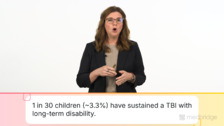
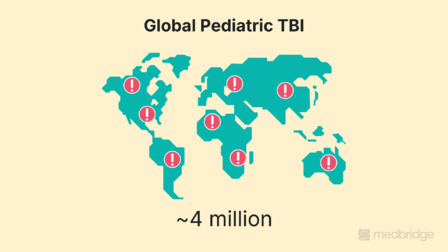
This chapter provides an overview of the incidence and prevalence of pediatric TBI, highlighting its status as a major public health issue. The discussion includes age-related vulnerability, common post-injury deficits, and how TBI compares with other developmental diagnoses, such as autism. Clinicians must understand these trends in order to contextualize assessment and anticipate the range of challenges a child may face following injury.
2. The Intersection of Injury and Development Throughout Recovery
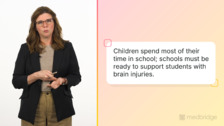
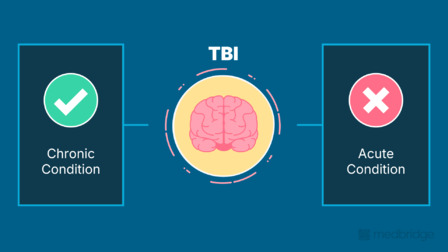
In this chapter, learners examine how the timing of a TBI interacts with critical developmental windows, affecting recovery trajectories. Key risk and protective factors are explored, including injury severity, socioeconomic status, and family stress. The chapter reframes TBI as a chronic condition with evolving effects, underscoring the need for long-term support and developmental monitoring into adolescence and young adulthood.

3. Assessment in Pediatric TBI
This chapter introduces a comprehensive assessment approach using the ICF framework to capture the multifaceted impact of pediatric TBI. Clinicians will learn how to gather a credible injury history, select appropriate standardized tools, and evaluate real-world participation and contextual influences. Emphasis is placed on assessing functional communication and cognitive-communication skills across settings to guide meaningful, individualized interventions.

Frequently asked questions
Everything you need to know about Medbridge courses.
Who creates Medbridge courses?
We work with industry-leaders, top researchers, and consultants to build content roadmaps that are then structured into courses, filmed, and edited by our production team before being launched to our site.
How often does Medbridge release new courses?
New courses are added monthly and are automatically included in your subscription as they launch.
How often does Medbridge update courses?
Medbridge reviews its courses annually for relevance and to assess if content is up to date. Based on these reviews it may be determined that a course is out of date resulting in the course being re-filmed or retired, if the content is no longer needed (e.g. a replacement course already exists, the concepts are no longer best practice, etc.).
How many courses does Medbridge offer?
We have over 3,000 accredited courses and we are continually updating our library with new courses. Check our course library for the most up-to-date count for your discipline.
Are there any additional fees for taking a Medbridge course?
There are no additional fees for taking a Medbridge course, obtaining a course certificate of completion, earning CEUs as a subscriber, or accessing any of the additional tools your subscription may include.
Is there a limit to the number of courses I can take?
There is no limit to the number of courses you can take as a subscriber! As a subscriber to Medbridge, you have unlimited access to over 3,000+ accredited CE courses.
If you are a Premium subscriber, you also have unlimited access to our Patient Engagement Tools such as the Home Exercise Program, Patient Education Library, Orthopedic Exam Tests, and Manual Therapy Techniques. We have over 7,000 exercises and over 650+ videos and handouts of patient education resources with more exercises and patient education added to the library based on subscriber feedback, volume of request and specialities.
What is your refund policy?
You are eligible for a refund provided your request is received within 30 days of your subscription purchase and your account has no activity.