
The Intentional HEP: 5 Task-Based Strategies That Improve Neuro Rehab Carryover
Help patients carry progress from the clinic into everyday life. Learn how task-based neuro rehab exercises can improve mobility, balance, and functional carryover at home. Plus explore 42 new neuroplasticity-focused HEP exercises for functional mobility training.
May 20, 2026
8 min. read
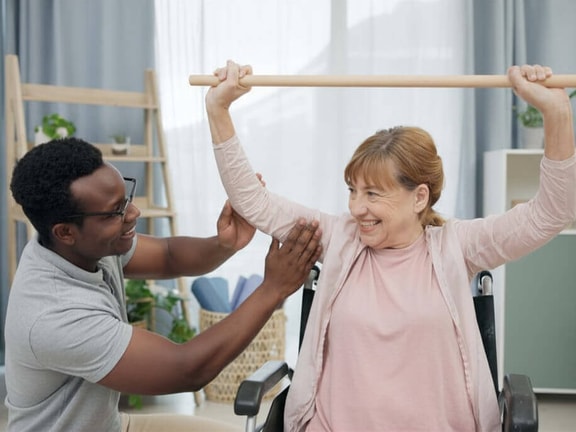
The golden rules of neuroplasticity (intensity, salience, and specificity) are the foundation of effective neurological rehabilitation. However, for many clinicians, the greatest challenge lies in translating these high-level principles into a home program that a patient can accurately execute without direct, hands-on guidance.
Standard home exercises often fall into the trap of being “too clinical and not functional enough.” Straight leg raises, for example, are great for range of motion, but they don't teach a patient how to safely navigate a shower ledge or regain independence in the bathroom.
To bridge this gap, we have launched 42 neuroplasticity home exercises, developed in tandem with our newest courses from J.J. Mowder-Tinney and Angie Reimer. These videos provide clinicians with a tangible way to operationalize high-level motor learning principles directly in the patient's home environment.
The philosophy: Why task-based movement wins
Neuroplasticity isn't just about doing a movement over and over. It’s about meaningful repetition. Research tells us that for the brain to reorganize, the task must be salient.1
This collection moves away from isolated muscle activation and toward functional, task-based movements. By simulating the physical demands of activities of daily living (ADLs)—like dressing, toileting, and transitions—the nervous system receives the specific input it needs to drive motor learning and long-term carryover.
Clinical spotlights: Five strategies for higher-level functional gains
To select the right exercise, clinicians can utilize a four-step clinical reasoning framework: identifying the task, assessing the person’s limiters, modifying the environment, and choosing a motor learning strategy (MLS). This approach ensures that every repetition assigned in a home exercise program (HEP) is purposeful and measurable.
While the full collection includes 42 new videos, these five featured exercises highlight how to address specific compensatory patterns using the environment and MLS pillars of clinical reasoning.
1. Addressing posterior loss of balance: Seated weight shift for toilet hygiene
Many patients exhibit “retropulsion” or a fear-based stiffening of the trunk when reaching backward or downward, often leading to a loss of balance during hygiene tasks.
The insight: This exercise targets the Anterior-Posterior (A-P) weight shift. By practicing this in a seated position, you lower the threat to the nervous system, allowing the patient to focus on dissociating trunk movement from hip stability.
To progress this, have the patient hold a weighted object further away from their body. This increases the leverage acting on the trunk, forcing the nervous system to work harder to maintain balance.
2. Solving "foot-drag" with external cues: Standing hula hoop lower body dressing
Patients often struggle with foot clearance due to a lack of hip flexion "timing" or excessive hip hiking.
The insight: This uses an external focus of attention. The hula hoop serves as a physical constraint that requires a specific trajectory of the limb. Research suggests that focusing on the hoop (the effect of the movement) rather than the hip (the body part) leads to faster motor acquisition and better carryover to actual dressing.2
3. Enhancing frontal plane stability: Side stepping over shower ledge
Navigating a bathroom requires a dynamic single-limb stance and the ability to clear obstacles laterally. This is a common point of failure for patients with stroke or multiple sclerosis.
The insight: This exercise utilizes environmental modification to practice a high-risk transition safely. By simulating the shower ledge, the patient practices the precise hip abductor strength and pelvic stability required for safe bathroom entry and exit.
4. Integration of visual and vestibular systems: Standing dowel mobility around head
Many neurological patients become visually dependent, meaning their balance crumbles the moment they have to look away from the floor or move their head.
The insight: This exercise targets functional shoulder amplitude while simultaneously challenging the vestibular system. Moving the dowel around the head forces the eyes to track and the vestibular system to stabilize the trunk amidst a changing visual field, which is essential for washing hair or reaching into a cupboard.
5. Training the rotational blueprint: Supine rolling to prop on elbow
A common barrier in bed mobility is log-rolling or using momentum rather than segmental rotation.
The insight: This isn't just a core exercise, but a functional prime. It isolates the diagonal reach and the transition to the elbow. By repeating this specific blueprint, the patient reinforces the coordination between the shoulder girdle and the contralateral hip, which is the mechanical key to independent bed mobility.
Maximizing carryover: Dosing and safety at home
When prescribing these high-level tasks, two questions are paramount: “How much is enough?” and “Is it safe?”
The neuroplasticity dose: Aim for success with challenge. If a patient completes 10 reps perfectly, increase the environmental challenge (for example, move from a firm surface to a foam pad) to keep the nervous system engaged.
Safety and support: For exercises involving the hula hoop or dowel, patients should practice near a corner or have a sturdy surface nearby for touch cues to prevent falls during high-challenge repetitions.
The value of error: Remind patients that making mistakes, such as losing balance slightly or missing a target, is a necessary part of the learning process. These exercises are designed to let the nervous system feel the error and self-correct.
How to find the neuroplasticity HEP collection
These exercises are now live in the Medbridge HEP library. To find them, use the following filters:
List Filter → Specialty → Neurology
Subcategories: Stroke, Parkinson's, Multiple Sclerosis, and Traumatic Brain Injury.
Below is the complete list of the new exercises now available in the Medbridge HEP library:
Alternating Supine Rolling to Prop on Elbow
Supine Rolling to Prop on Left Elbow With Diagonal Reach
Supine Rolling to Prop on Right Elbow and Hand With Diagonal Reach
Seated Reach to Floor Bilateral
Seated Reach to Floor Right
Punching Theraband Wrap Sitting
Sitting to Half Kneel with Right Leg Under Chair
Sitting to Half Kneel with Left Leg Under Chair
Sitting Rotation to Half Kneel With Reach With Right Arm
Sitting Rotate and Reach with Left Upper Extremity
Sitting Rotation to Half Kneel to the Right
Sitting Rotation to Half Kneel to the Left
Standing to Half Kneel on Right Knee and Back Up to Standing
Standing to Kneeling to Standing
Standing to Half Kneel on Left Knee and Back Up to Standing
Side Stepping Over Shower Ledge
Standing Hula Hoop Upper Body Dressing
Hula Hoop Over Body and Step Out
Standing Hula Hoop Lower Body Dressing
Standing Lower Body Dressing Simulation with Theraband
Punching Theraband Wrap Standing
Kneeling to Half Kneel with Right Leg Up
Kneeling to Half Kneel with Left Leg Up
Kneeling Alternating Legs to Half Kneel
Supine to Sidelying Resisted Serratus Punch
Supine Bridging with Resistance
Standing Dowel Mobility Around Head (Functional Shoulder Amplitude Practice)
Seated Reach to Floor Left
Sitting Pushing Walker Forward With Theraband Resistance
Supine to Sidelying Resisted Reaching
Hooklying Sliding Up and Down in Bed with Frictionless Sheet
Rolling with Lower Extremity Movement on Frictionless Sheet
Sitting Leaning Forward on Thighs with Forearm Pressure
Sitting Weight Shifting with Forearms on Thighs
Seated Weight Shift for Toilet Hygiene
Seated Hula Hoop Upper Body Dressing
Seated Hula Hoop Lower Body Dressing
Seated Lower Body Dressing Simulation with Theraband
Stepping Over Shower Ledge Forward
Seated Reach Rotation Across Body
Seated Reach Forward
Sitting Pushing Cane Forward with Theraband Resistance
Beyond the videos: Streamlining your workflow
The Medbridge HEP library is designed to solve the common implementation gaps that hinder neuro-rehab:
Customizable templates: Quickly drag and drop these new task-based videos into existing templates to spend less time on administrative work and more time on the patient.
Seamless sharing: Send programs directly via text, email, or QR code to ensure patients have high-quality visual cues for their homework between clinic visits.
Integrated tracking: Leverage Remote Therapeutic Monitoring (RTM) and Patient-Reported Outcomes (PROs) with your HEP to monitor adherence and adjust the challenge level as your patient progresses toward independence.
Take the deep dive
Higher level mobility training isn't about doing harder exercises—it’s about doing smarter ones. To see exactly how J.J. Mowder-Tinney and Angie Reimer integrate these exercises into practice, explore their comprehensive course series:
Clinical Reasoning and Motor Learning: Bed Mobility, Transfers, Walking—Learn to evaluate movement limitations and design targeted, task-specific interventions for foundational mobility. This course uses video demonstrations with real patients to show how strategies like error augmentation, repetition, and motor priming drive functional progress across different stages of recovery.
Clinical Reasoning and Motor Learning: Dressing, Toileting, Bathing—Apply the four-step framework to essential self-care tasks. Clinicians will learn to analyze task demands and modify environmental factors to rebuild daily function and self-efficacy through purposeful, patient-centered practice.
Clinical Reasoning and Motor Learning: Higher-Level Mobility—Empower your practice with strategies for complex mobility, including floor-to-chair transfers, stair negotiation, and dual-tasking. This final installment provides practical tools to promote independence and community participation through real-time decision-making and case studies.
References
Gazerani, P. (2025). The neuroplastic brain: Current breakthroughs and emerging frontiers. Brain Research, 1858, 149643. https://www.sciencedirect.com/science/article/pii/S0006899325002021
Bryson, A. M., & Zea, M. D. (2023). The effects of motor fluency on dressing tasks and decreasing escape behaviors. Behavior Analysis in Practice, 17(1), 316–322. https://pmc.ncbi.nlm.nih.gov/articles/PMC10891001/
Meet the Author


Subscribe to Our Newsletter
Related Posts
May 18, 2026
Real-World Mobility Gains: A Four-Step Framework for Intentional Neuro Rehab
By Angie Reimer and J.J. Mowder-Tinney
January 10, 2025
Top 5 Exercises for Hip Osteoarthritis
By Medbridge
January 15, 2026
Sitting Balance Scale: A Practical Tool for Early Fall Risk Identification
By Medbridge
April 9, 2024
9 Effective Exercises for Vestibular Hypofunction
By Morgan Kriz