Trauma-Informed Strategies for Pediatric OT and Speech Therapy Sessions
Trauma-informed care in pediatric therapy starts with understanding why a child might be quiet, watchful, or quick to become dysregulated. Melissa Sevestre, PhD, MOT, OTR/L, explains how adverse childhood experiences (ACEs) can show up in a session. She then shares the strategies she uses to help children feel safe, from visual schedules and feelings boards to preparing a child for a covering therapist.
October 21, 2026
7 min. read

When I first started working with a boy who was 10, he barely said anything to me. I’d ask a question and get a yes or a no, and he wouldn’t look at me. I had to build rapport with him slowly, and I later learned that part of his silence was a stress response.
Many children with adverse childhood experiences (ACEs) come to therapy showing a stress response like his. They may be quiet, watchful, or quick to become dysregulated, and those behaviors make more sense once you understand where they come from. That understanding is where trauma-informed care in pediatric therapy begins.
As an occupational therapist or speech-language pathologist, you can give a child something their daily life may be missing: a place where they feel safe, heard, and able to predict what happens next.
What ACEs can look like in a therapy session
An ACE is any event a child experiences as stressful or traumatic, and the child’s perception is what counts. You may never have lived through something similar, and you might not see it as traumatic yourself, but if it’s traumatic to the child, it belongs in your clinical reasoning.
ACEs can include abuse, neglect, divorce, a family member who is incarcerated, and violence in the home or community. When a child lives in a state of continuous stress, that becomes toxic stress, and it follows them into school, play, and your sessions.
In therapy, that heightened stress response often shows up as:
Quiet or distrust. The child may not talk to you, may answer in single words, or may avoid eye contact until trust is built.
Watchfulness. If you get up to grab materials, the child may keep their eyes on you, because they aren’t sure yet what you’re going to do.
Trouble with transitions. A substitute teacher or a therapist covering your caseload can be very hard on a child who has built a strong relationship with you.
Emotional and behavioral dysregulation. The child may yell or cry over something that seems small, in a way you wouldn’t expect for their age.
A change in behavior is worth noticing, too. A child who is suddenly quieter than usual—or more aggressive than you’re used to—may be telling you that something is going on. Look for the why before you assume it’s just how the child is acting that day. A thorough history helps, and I also like to talk with the child when the parent isn’t in the room, because children won’t always share what’s happening at home in front of a caregiver.
Make emotional safety your first priority
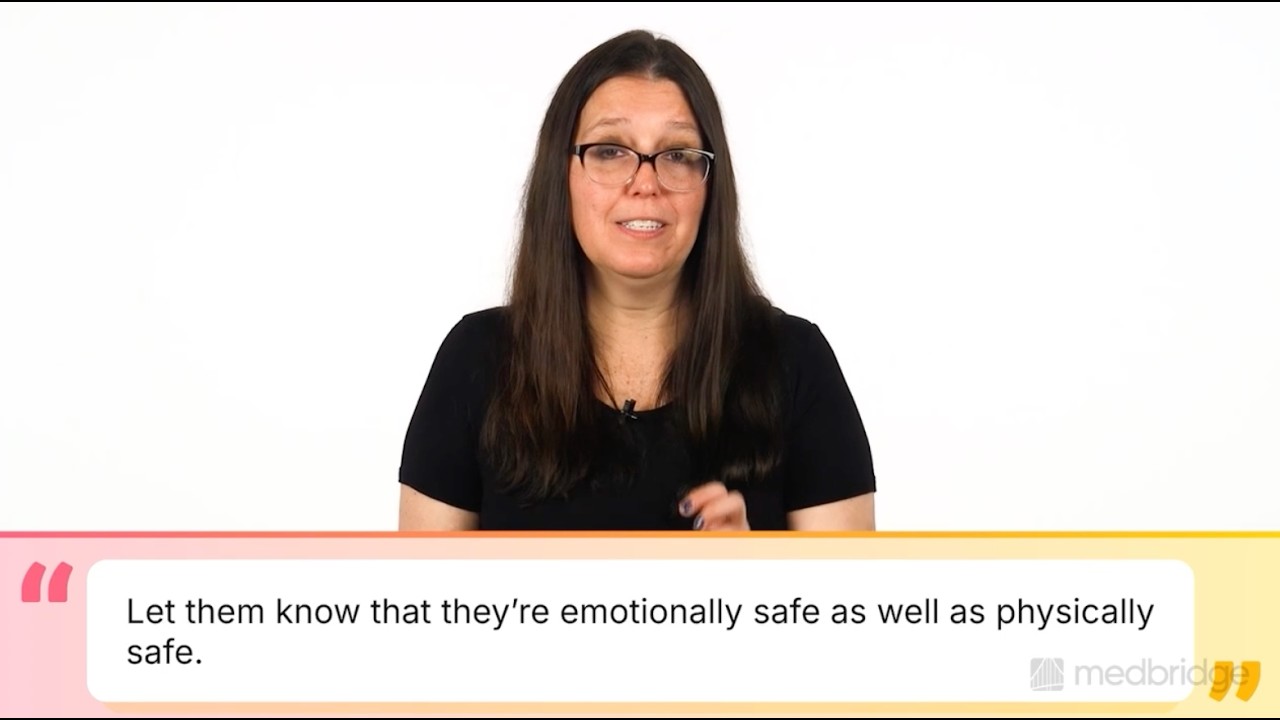
I tell my occupational therapy students that safety is their number one job with every patient, and that means physical, cognitive, and emotional safety. If a child is constantly worried about what will happen next at home, you can be the stability they need.
Earlier in my career, I worked in a sensory integration gym with ziplines and monkey bars, and we always had crash pads underneath in case a child fell. Emotional safety works the same way. Before a child can take on the hard parts of therapy, they need to know they’re protected if something goes wrong.
Create a predictable session structure
Children love routines, and for a child whose home life is unpredictable, routines can be hard to come by. You can build that predictability into every session.
Start with a visual schedule that the child checks off as you go so they know exactly what you’ll do together today. Then offer a choice inside that structure. You might say, “After we do these two activities, which one would you like to do last?” The choice gives the child some control, and the schedule tells them what comes next.
Build rapport by asking the child directly
It’s common to ask a parent how the child’s day went, and that information is valuable. Ask the child too. Even a child with limited verbal communication will tell you a lot through nonverbal cues, like whether they’re smiling, looking down, or fidgeting with their hands. A communication board with feelings such as happy, sad, and angry gives that child a way to tell you how they’re doing today.
Pay attention to what comes out during activities as well. As an OT, I look closely at art and writing tasks, because what a child chooses to write about or draw can point you toward something that’s going on. The more rapport you build, the more likely the child is to tell you what you need to know for treatment. Sometimes the child will share something a parent was too embarrassed to mention, like a need for support services the family could use.
Prepare children for therapist absences and caseload coverage
Picture a child you’ve seen for months. You go on vacation, and when you come back, you learn the sessions with the covering therapist went badly, with fits, trouble following directions, and a hard week overall. Before you chalk it up to an off day, consider how difficult that transition was for the child.
You can make it easier by talking to the child before you leave. You don’t have to say where you’re going. Something as simple as “I’m not going to be here next week, but you’re going to be with [therapist’s name], and you’re going to do great” goes a long way. Introduce the child to the covering therapist ahead of time, too, so they know who to expect and feel safe with the change.
Respond to big emotions by asking what happened
When a child starts crying and you can’t see the reason, it’s tempting to ask, “Why are you crying?” I’d take that question out of your vocabulary. It’s okay for a child to cry, and what you need is to understand what’s behind it. Ask, “What happened, and how can I help you?” Then you can teach the child a way to cope the next time it happens.
Keep development in mind here. Tantrums are an expected part of being 2 to 4 years old, and by around age 4, children start working toward understanding other people’s perspectives. An older child who still responds this way may be showing you the effects of stress, and that’s information you can bring into your treatment plan.
Teach coping strategies that fit the child
A coping strategy that works for you, or for another child on your caseload, won’t necessarily work for this one. Find out what the child likes and is able to do, and build strategies around that, choosing ones that suit their age.
I’ve made coping-strategy books for children to look through, and laminated cards that say “When I feel unsafe, I will ______,” which a child can pull out whenever they need a reminder of what to do. I go further into these tools in my course Building Resilient Youth: Coping Strategies for Rehab Professionals.
Adjust treatment to the child’s developmental needs
A child’s age won’t always tell you where they are developmentally. A child might be right on track physically and still be behind cognitively or emotionally. When you see that gap, adjust your treatment to meet the child where they are and let their developmental needs guide the plan.
Understand the child’s lived experience
To help these children, you have to understand what they’ve been through, including what happened long before they walked into your clinic. That means asking questions, talking with the caregiver, and talking with the child. Once you know the child, you can create a treatment plan that addresses their mental health and developmental needs together and, most of all, keeps them safe.
To see how ACEs and social drivers of health come together in one child’s care, watch my course The Impact of ACEs and SDOH on Youth Mental Health. It walks through a detailed case study of a young child referred for occupational, speech, and physical therapy, and shows how a thorough history changed the treatment plan.
Below, watch Melissa Sevestre discuss how to create emotional safety for children in therapy in this brief clip from her Medbridge course “The Impact of ACEs and SDOH on Youth Mental Health.”
Meet the Author