
Human Trafficking for Health Care Professionals: Michigan (2026)
Presented by Hanni Stoklosa
A majority of human trafficking victims access health care in the United States while being exploited. This represents a critical opportunity and responsibility for health professionals to intervene in victims’ lives, setting them on a path toward health and healing. This course will provide an overview of human trafficking, including its US definition, the scope of the problem, and vulnerabilities that can lead someone to be trafficked. Further, it will provide specific guidance to health professionals on signs to identify human trafficking victims, methods for assessment, and recommended intervention protocols. The course will review common mistakes when assessing for trafficking, practical advice on implementation of trauma-informed care, the role of unconscious bias in caring for trafficking victims, and links between the opioid epidemic and human trafficking. This program meets the Michigan human trafficking training requirements for health care providers.
Meet your instructor

Hanni Stoklosa
Hanni Stoklosa, MD, MPH, is the executive director of HEAL Trafficking and an emergency physician at Brigham and Women’s Hospital with appointments at Harvard Medical School, Harvard T.H. Chan School of Public Health, and the Harvard Humanitarian Initiative. She is the director of the Global Women's Health Fellowship at the…
Chapters & learning objectives

1. Introduction Human Trafficking and Affected Populations
This section will provide an overview of human trafficking, including its definition, the scope of the problem, and common industries of exploitation. Dr. Stoklosa will address common myths and misconceptions in this portion.

2. How to Identify a Trafficked Person
A majority of trafficking victims access health care at some point during their exploitation. But what are the health consequences of trafficking that may lead someone to health care, and what are the signs health professionals should look for? This section will also include a discussion of the role of unconscious bias in assessment for human trafficking.
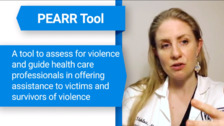
3. Inquiry and Assessment for Human Trafficking
Using research from trafficking survivors and lessons learned from domestic violence, Dr. Stoklosa will review step-by-step approaches to assess potential trafficking victims, including common pitfalls in assessment. Dr. Stoklosa will provide potential inquiry questions.

4. Trauma-Informed Care: Referral and Service Options
What does trauma-informed care mean? How do we go from the theoretical to the practical? What are some tips and tricks each of us can use to embrace principles of trauma-informed care in our work, especially with victims of trafficking? We will review categories of referral options, including for social and legal services, and the National Human Trafficking Resource Center.

5. Establishing a Protocol in Your Health Care Setting
HEAL Trafficking published a protocol toolkit in 2017 that has been guiding health systems to respond to trafficking in more than 35 countries across the globe. Dr. Stoklosa will give an overview of some core components of trafficking protocols and how to develop them in your health system.

6. State-Specific Rules: Michigan
This chapter reviews Michigan-specific vulnerabilities to trafficking, and guidance regarding mandated reporting requirements


Frequently asked questions
Everything you need to know about Medbridge courses.
Who creates Medbridge courses?
We work with industry-leaders, top researchers, and consultants to build content roadmaps that are then structured into courses, filmed, and edited by our production team before being launched to our site.
How often does Medbridge release new courses?
New courses are added monthly and are automatically included in your subscription as they launch.
How often does Medbridge update courses?
Medbridge reviews its courses annually for relevance and to assess if content is up to date. Based on these reviews it may be determined that a course is out of date resulting in the course being re-filmed or retired, if the content is no longer needed (e.g. a replacement course already exists, the concepts are no longer best practice, etc.).
How many courses does Medbridge offer?
We have over 3,000 accredited courses and we are continually updating our library with new courses. Check our course library for the most up-to-date count for your discipline.
Are there any additional fees for taking a Medbridge course?
There are no additional fees for taking a Medbridge course, obtaining a course certificate of completion, earning CEUs as a subscriber, or accessing any of the additional tools your subscription may include.
Is there a limit to the number of courses I can take?
There is no limit to the number of courses you can take as a subscriber! As a subscriber to Medbridge, you have unlimited access to over 3,000+ accredited CE courses.
If you are a Premium subscriber, you also have unlimited access to our Patient Engagement Tools such as the Home Exercise Program, Patient Education Library, Orthopedic Exam Tests, and Manual Therapy Techniques. We have over 7,000 exercises and over 650+ videos and handouts of patient education resources with more exercises and patient education added to the library based on subscriber feedback, volume of request and specialities.
What is your refund policy?
You are eligible for a refund provided your request is received within 30 days of your subscription purchase and your account has no activity.