
Assessing Autism in a Changing Society: History and Diagnostic Challenges
Presented by JL Parker
This course explores the evolution of autism diagnoses and the implications of shifting diagnostic criteria within the DSM framework. By examining the historical development of autism classification and the transition to the DSM-5, learners will gain insight into how diagnostic changes have influenced prevalence rates, service access, and insurance coverage. The course highlights the clinical challenges associated with applying current diagnostic standards and considers the impact of diagnostic coding on therapy access and public health data. Designed for speech-language pathologists and other healthcare professionals working in educational, clinical, or community-based settings, this course aims to foster critical reflection on equitable diagnostic practices and promote informed, evidence-based assessments of individuals with suspected autism spectrum disorder.
Learning Outcomes
- Analyze how diagnostic practices influence the prevalence of autism spectrum disorders in the US
- Differentiate between DSM-5 and prior diagnostic criteria to identify specific clinical challenges in diagnosing autism spectrum disorders
- Integrate diagnostic coding knowledge with resource allocation data to determine how coding influences therapy service utilization
Meet your instructor

JL Parker
JL Parker, PhD, CCC-SLP, is a highly accomplished speech-language pathologist and educator with an extensive background in clinical practice and academic instruction. She earned her PhD in interdisciplinary health sciences from Western Michigan University and holds both a master’s and bachelor’s degree from Central Michigan…
Chapters & learning objectives
1. A Brief History of Autism in the DSM
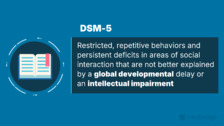
This chapter outlines the historical development of autism as a clinical diagnosis and traces its evolving definitions through successive editions of the DSM. Special focus is given to the significant changes introduced in the DSM-5, including the shift from a triad to a dyad of criteria and the consolidation of subtypes under autism spectrum disorder. Understanding these changes is essential for speech-language pathologists to grasp the foundations of current diagnostic practices and to interpret assessment outcomes with historical context in mind.

2. Challenges of the DSM-5
This chapter explores the diagnostic and statistical issues introduced by the DSM-5, particularly the reduced reliability and misalignment with earlier classifications. Learners will examine how these challenges affect prevalence data and influence research, funding, and access to care. The content emphasizes how speech-language pathologists must navigate diagnostic uncertainty while advocating for appropriate services.
3. Autism and Insurance
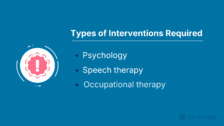
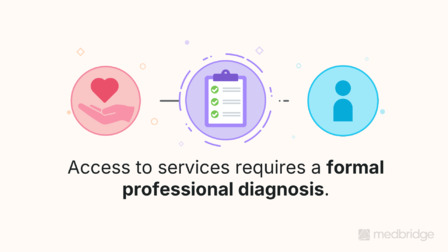
This chapter examines the relationship between autism diagnoses and insurance coverage, highlighting how diagnostic codes directly influence access to providers, therapies, and support services. It underscores the ethical and clinical consequences of over- or underdiagnosis, particularly given limited service availability. Speech-language pathologists will gain a deeper understanding of how insurance dynamics shape evaluation practices and resource distribution for individuals with autism.

Frequently asked questions
Everything you need to know about Medbridge courses.
Who creates Medbridge courses?
We work with industry-leaders, top researchers, and consultants to build content roadmaps that are then structured into courses, filmed, and edited by our production team before being launched to our site.
How often does Medbridge release new courses?
New courses are added monthly and are automatically included in your subscription as they launch.
How often does Medbridge update courses?
Medbridge reviews its courses annually for relevance and to assess if content is up to date. Based on these reviews it may be determined that a course is out of date resulting in the course being re-filmed or retired, if the content is no longer needed (e.g. a replacement course already exists, the concepts are no longer best practice, etc.).
How many courses does Medbridge offer?
We have over 3,000 accredited courses and we are continually updating our library with new courses. Check our course library for the most up-to-date count for your discipline.
Are there any additional fees for taking a Medbridge course?
There are no additional fees for taking a Medbridge course, obtaining a course certificate of completion, earning CEUs as a subscriber, or accessing any of the additional tools your subscription may include.
Is there a limit to the number of courses I can take?
There is no limit to the number of courses you can take as a subscriber! As a subscriber to Medbridge, you have unlimited access to over 3,000+ accredited CE courses.
If you are a Premium subscriber, you also have unlimited access to our Patient Engagement Tools such as the Home Exercise Program, Patient Education Library, Orthopedic Exam Tests, and Manual Therapy Techniques. We have over 7,000 exercises and over 650+ videos and handouts of patient education resources with more exercises and patient education added to the library based on subscriber feedback, volume of request and specialities.
What is your refund policy?
You are eligible for a refund provided your request is received within 30 days of your subscription purchase and your account has no activity.