
ED PT Practice: Building Your ED PT Practice
Presented by Rebekah Griffith
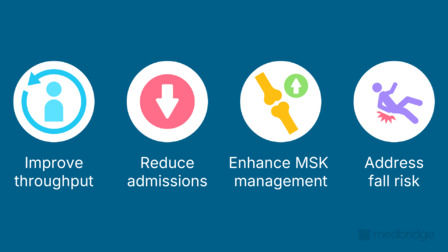
This course provides a comprehensive roadmap for developing and sustaining a physical therapy practice within the emergency department (ED). From transitioning out of pilot programs to defining scalable staffing and scheduling models, participants will learn how to build infrastructure that supports long-term success. The course emphasizes the importance of interprofessional collaboration, data-driven planning, and adaptable practice models aligned with department needs. Designed for physical therapists, administrators, and program leads, this course equips learners with the strategies and tools needed to embed PT into the ED effectively and sustainably across diverse healthcare settings.
Learning Objectives
- Plan the transition from pilot implementation to a sustainable ED PT model
- Develop scalable staffing and scheduling structures to meet patient and departmental needs
- Use operational data to support practice growth, demonstrate value, and refine clinical delivery models
- Determine key collaborators, roles, and support structures needed to sustain long-term ED PT success
This course is part of a six part series on Emergency Department PT practice:
Meet your instructor

Rebekah Griffith
Dr. Rebekah Griffith specializes in emergency department care. Dr. Griffith believes physical therapist practice in the emergency department is a critical way to move upstream in healthcare, supporting patients during their most critical moments. Dr. Griffith has been an invited lecturer, a regular presenter, a podcast guest,…
Chapters & learning objectives

1. Planning for Sustainable Integration
This chapter focuses on the essential components of transitioning from a pilot ED PT program to a permanent, scalable model. Participants will explore questions around staffing, department flow, equipment, and alignment with hospital operations. Emphasis is placed on anticipating logistical needs and using early collaboration with stakeholders to build a strong foundation for lasting integration.

2. Establishing Multidisciplinary Support
Highlighting the role of interprofessional collaboration, this chapter guides learners through identifying key allies such as physicians, advanced practice providers, nurses, and ancillary staff. Strategies are shared to build clinical trust, encourage referrals, and establish the PT as a vital contributor to ED care. Sustained success is framed as a team achievement driven by communication and shared goals.
3. Clarifying Your Practice Model
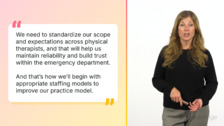
This chapter helps participants define their ED PT service by analyzing operational variables like staffing, scheduling, scope of practice, and workflow alignment. It outlines multiple practice and staffing models—embedded, on-call, hybrid, and direct triage—and helps clinicians tailor their approach based on institutional structure and patient volume. Setting clear expectations improves consistency and team reliability.

4. Gathering and Leveraging the Data
Focusing on practical tools for planning and evaluation, this chapter shows participants how to gather and interpret operational data to guide implementation. Topics include volume tracking, patient arrival patterns, productivity metrics, and resource needs. Participants will learn how to use data not only to support decision-making but also to advocate for the growth and sustainability of their ED PT practice.
More courses in this series

ED PT Practice: Foundations for Emergency Department Care
Rebekah Griffith

ED PT Practice: Demonstrating Value and Defining the Role of the ED PT
Rebekah Griffith

ED PT Practice: Addressing Barriers and Operational Challenges
Rebekah Griffith

ED PT Practice: Building Your ED PT Practice
Rebekah Griffith
ED PT Practice: Launching Your ED PT Practice
Rebekah Griffith
ED PT Practice: Practicing at Top of Scope
Rebekah Griffith
Frequently asked questions
Everything you need to know about Medbridge courses.
Who creates Medbridge courses?
We work with industry-leaders, top researchers, and consultants to build content roadmaps that are then structured into courses, filmed, and edited by our production team before being launched to our site.
How often does Medbridge release new courses?
New courses are added monthly and are automatically included in your subscription as they launch.
How often does Medbridge update courses?
Medbridge reviews its courses annually for relevance and to assess if content is up to date. Based on these reviews it may be determined that a course is out of date resulting in the course being re-filmed or retired, if the content is no longer needed (e.g. a replacement course already exists, the concepts are no longer best practice, etc.).
How many courses does Medbridge offer?
We have over 3,000 accredited courses and we are continually updating our library with new courses. Check our course library for the most up-to-date count for your discipline.
Are there any additional fees for taking a Medbridge course?
There are no additional fees for taking a Medbridge course, obtaining a course certificate of completion, earning CEUs as a subscriber, or accessing any of the additional tools your subscription may include.
Is there a limit to the number of courses I can take?
There is no limit to the number of courses you can take as a subscriber! As a subscriber to Medbridge, you have unlimited access to over 3,000+ accredited CE courses.
If you are a Premium subscriber, you also have unlimited access to our Patient Engagement Tools such as the Home Exercise Program, Patient Education Library, Orthopedic Exam Tests, and Manual Therapy Techniques. We have over 7,000 exercises and over 650+ videos and handouts of patient education resources with more exercises and patient education added to the library based on subscriber feedback, volume of request and specialities.
What is your refund policy?
You are eligible for a refund provided your request is received within 30 days of your subscription purchase and your account has no activity.