
Foundations of Neurodiversity-Affirming Practice
Presented by Amy L. Donaldson and endever* corbin
This course addresses the historical disconnect between traditional clinical practices and the lived experiences of autistic people by advocating for a paradigm shift toward neurodiversity-affirming care. Many healthcare providers rely on a “clinician-as-expert” model that often views disability as a deficit to be fixed, which can inadvertently marginalize patients and limit their autonomy. By examining the evolution of disability models—from medical to social and biopsychosocial—participants will learn to recognize how their own conceptualizations of disability impact service provision and patient agency. The course further explores the importance of identity-affirming language, the “double empathy problem,” and the necessity of presuming competence in all communicators. This training is designed for speech-language pathologists, educators, and healthcare professionals working in outpatient clinics, schools, and diverse clinical settings. Through case-based activities and self-reflection, learners will gain practical strategies for strengths-based documentation and collaborative partnership with the autistic community.
Learning Outcomes
- Contrast the medical, social, and biopsychosocial models of disability and their impact on the autistic person’s access, agency, and self-determination, as well as the professional’s service provision
- Apply neurodiversity-affirming language and classification alternatives, such as “support needs,” in clinical documentation
- Analyze the “double empathy problem” and its role in mutual communication breakdowns between neurotypes
- Plan strengths-based intervention goals that prioritize self-advocacy and quality of life over normalization
- Implement strategies to respect bodily autonomy and privacy, including the ethical management of “harmless stimming” and sensitive clinical information
Meet your instructors

Amy L. Donaldson
Amy L. Donaldson, PhD, CCC-SLP, is a professor in the Department of Speech & Hearing Sciences at Portland State University. Using a participatory research framework, she is interested in examining communication choice, access, and agency, as well as social interaction and relationship development in partnership with the…

endever* corbin
endever* corbin (name is lowercase; the star is silent; pronouns are they/them/theirs or xe/xem/xyrs) is a multiply disabled, mostly-nonspeaking Autistic self-advocate. Their multimodal communication methods include a symbol-based AAC device, typing, ASL, letterboards, some mouthwords, and more. As a community research…
Chapters & learning objectives
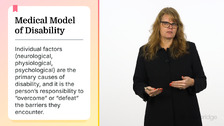
1. The Impact of Disability Models
This chapter contrasts the medical, social, and biopsychosocial models of disability to illustrate how different frameworks influence a professional’s approach to patient care and agency. It is essential for clinicians to understand these models because their personal lens directly shapes how they assess skills, create goals, and interact with disabled individuals.
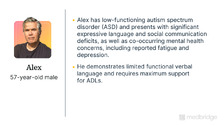
2. Neurodiversity and Autistic Identity
Participants will explore the biological fact of neurodiversity and the critical role that identity-affirming language, such as “autistic person” versus “person with autism,” plays in clinical practice. Understanding these nuances allows providers to move away from stigmatizing functioning labels and instead utilize a support-needs framework that respects individual autonomy and community preferences.

3. Communication Myths and the Double Empathy Problem
This chapter challenges the perceived superiority of spoken language and introduces the “double empathy problem,” which identifies communication breakdowns as a mutual mismatch between different neurotypes rather than an individual deficit. By prioritizing the presumption of competence and age-appropriate engagement, healthcare providers can better support the rights and diverse communicative needs of every patient.
Frequently asked questions
Everything you need to know about Medbridge courses.
Who creates Medbridge courses?
We work with industry-leaders, top researchers, and consultants to build content roadmaps that are then structured into courses, filmed, and edited by our production team before being launched to our site.
How often does Medbridge release new courses?
New courses are added monthly and are automatically included in your subscription as they launch.
How often does Medbridge update courses?
Medbridge reviews its courses annually for relevance and to assess if content is up to date. Based on these reviews it may be determined that a course is out of date resulting in the course being re-filmed or retired, if the content is no longer needed (e.g. a replacement course already exists, the concepts are no longer best practice, etc.).
How many courses does Medbridge offer?
We have over 3,000 accredited courses and we are continually updating our library with new courses. Check our course library for the most up-to-date count for your discipline.
Are there any additional fees for taking a Medbridge course?
There are no additional fees for taking a Medbridge course, obtaining a course certificate of completion, earning CEUs as a subscriber, or accessing any of the additional tools your subscription may include.
Is there a limit to the number of courses I can take?
There is no limit to the number of courses you can take as a subscriber! As a subscriber to Medbridge, you have unlimited access to over 3,000+ accredited CE courses.
If you are a Premium subscriber, you also have unlimited access to our Patient Engagement Tools such as the Home Exercise Program, Patient Education Library, Orthopedic Exam Tests, and Manual Therapy Techniques. We have over 7,000 exercises and over 650+ videos and handouts of patient education resources with more exercises and patient education added to the library based on subscriber feedback, volume of request and specialities.
What is your refund policy?
You are eligible for a refund provided your request is received within 30 days of your subscription purchase and your account has no activity.