Limb Symmetry Index: How to Calculate, Interpret, and Apply LSI in Rehabilitation
October 19, 2026
11 min. read
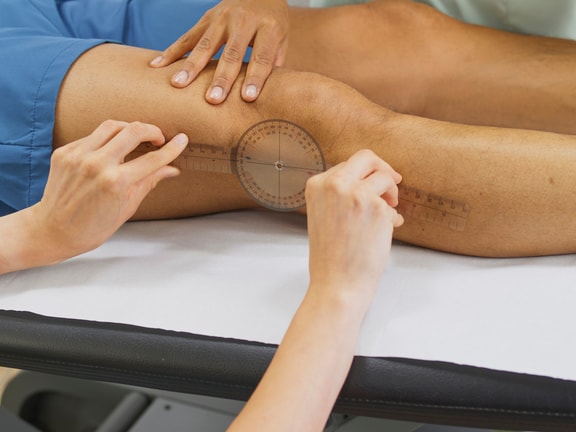
The limb symmetry index (LSI) is a common measure in rehabilitation and sports medicine for comparing strength, power, and functional performance between an injured limb and its uninjured counterpart. It gives clinicians a standardized way to monitor recovery, identify remaining deficits, and support decisions about progression through rehabilitation.
After injuries such as anterior cruciate ligament (ACL) tears, restoring strength and functional symmetry is often a primary rehabilitation goal. Similar performance between limbs does not automatically mean full recovery or readiness to return to sport, though, and research suggests that relying on symmetry alone can underestimate residual weakness and create a misleading picture of functional recovery.¹
This article covers how to calculate and interpret the limb symmetry index, the tests most often used to measure it, commonly cited thresholds, and where the measure falls short in return-to-sport decisions.
Limb Symmetry Index Calculator
Submit a few brief details to unlock your free Limb Symmetry Index calculator!
What Is the Limb Symmetry Index?
The limb symmetry index is a percentage-based measurement that compares the performance of an injured or involved limb with the opposite, uninvolved limb.
It is frequently used after lower-extremity injuries, particularly ACL reconstruction, to assess recovery in muscle strength, jumping ability, and functional performance.
An LSI of 100% indicates equal performance between the two limbs on the measured task. Values below 100% generally indicate that the involved limb is performing at a lower level than the uninvolved limb.
For example, a patient who achieves 85% of the hop distance of their uninjured leg would have an LSI of 85%, representing a 15% performance deficit relative to the comparison limb.
Common applications include:
ACL rehabilitation: Comparing quadriceps strength and hop performance after reconstruction.
Lower-extremity injury recovery: Monitoring functional differences after knee, ankle, or other lower-limb injuries.
Return-to-sport assessments: Evaluating strength and performance alongside movement quality and sport-specific demands.
Rehabilitation progress tracking: Identifying changes in side-to-side performance across multiple assessments.
The measurement is useful because it can be applied across several standardized strength and functional tests. LSI describes relative symmetry rather than absolute physical capacity, however, so a patient may achieve high symmetry while still demonstrating bilateral strength deficits.¹
How to Calculate the Limb Symmetry Index
The limb symmetry index formula depends on the performance variable being measured.
For strength, hop distance, and other measures where higher values represent better performance, the standard formula is:
Limb Symmetry Index (%) = (Involved Limb Performance ÷ Uninvolved Limb Performance) × 100
Both limbs must be measured using the same test, units, and conditions.
Limb Symmetry Index Calculation Example
Consider a patient completing single-leg hop testing six months after ACL reconstruction. The patient records the following distances:
Measurement | Distance |
Involved limb | 135 cm |
Uninvolved limb | 150 cm |
Limb symmetry index | 90% |
Using the formula:
LSI = (135 ÷ 150) × 100 = 90%
This result indicates that the involved limb achieved 90% of the hop distance recorded by the uninvolved limb.
The patient has reached a commonly referenced symmetry threshold, but strength testing, movement assessment, and psychological readiness still need to be evaluated before any return-to-sport decision.
Calculating LSI for Timed Tests
For measurements where lower values represent better performance, such as a timed hop test, the formula is reversed:
LSI (%) = (Uninvolved Limb Time ÷ Involved Limb Time) × 100
For example, if a patient completes a timed hop test in 5.0 seconds on the involved limb and 4.5 seconds on the uninvolved limb:
LSI = (4.5 ÷ 5.0) × 100 = 90%
Using the appropriate formula keeps the interpretation consistent: values below 100% generally represent reduced performance on the involved side.
What Is a Good Limb Symmetry Index?
An LSI of 90% or greater is frequently used as a benchmark in ACL return-to-sport testing, but the appropriate threshold depends on the assessment, the stage of rehabilitation, and the demands of the activity.²
LSI Score | General Interpretation |
Below 80% | Substantial side-to-side performance deficit |
80–89% | Remaining asymmetry, may meet selected rehabilitation progression criteria |
90–99% | Meets a commonly used symmetry benchmark for some return-to-sport tests |
100% | Equal measured performance between limbs |
Above 100% | Involved limb exceeds uninvolved limb performance |
These ranges are descriptive, not validated universal clearance categories. An individual score should be interpreted within the specific rehabilitation protocol and testing method.
The 2023 Aspetar clinical practice guideline includes quadriceps LSI above 80% among its proposed return-to-running criteria. For professional athletes returning to high-demand pivoting sports, it proposes 100% symmetry in isokinetic quadriceps and hamstring peak torque at 60°/s, alongside other performance measures.²
With running and return-to-sport criteria set that far apart, no single threshold fits every stage of rehabilitation.
Common Tests Used to Measure Limb Symmetry
Limb symmetry can be evaluated through several strength and functional assessments. Each test measures a different component of lower-extremity performance, so a combination of assessments is more informative than any single result.
1. Quadriceps and Hamstring Strength Testing
Muscle strength testing is widely used to evaluate recovery after knee injuries and ACL reconstruction. Common methods include:
Isokinetic dynamometry
Handheld dynamometry
Fixed dynamometry
Other standardized maximal strength assessments
Measurements may include peak torque, maximal force, or torque normalized to body mass.
Quadriceps strength is especially relevant after ACL reconstruction because persistent weakness can affect knee loading and athletic performance. In the Delaware-Oslo ACL cohort study, greater quadriceps strength symmetry before returning to high-demand sports was associated with a lower rate of knee reinjury.³
2. Single-Leg Hop Tests
Hop testing evaluates functional performance during movements that require lower-extremity strength, coordination, and power. Frequently used assessments include:
Hop Test | Measurement |
Single hop for distance | Distance covered during one maximal hop |
Triple hop for distance | Total distance covered across three consecutive hops |
Crossover hop for distance | Total distance covered across three consecutive hops, crossing a center line on each hop |
6-meter timed hop | Time required to hop a six-meter distance |
These tests are commonly included in ACL return-to-sport testing batteries.
Similar hop distances between limbs do not necessarily mean similar landing mechanics, joint loading, or movement strategies, so hop testing should include observation of movement control rather than distance or time alone.²
3. Jump Performance and Force Plate Testing
Force plate testing can provide additional insight into how each limb produces and absorbs force during functional movements.
Depending on the assessment protocol, force plates can measure:
Peak force
Eccentric braking impulse
Concentric impulse
Jump height
Rate of force development
Limb loading during landing
These measurements can reveal differences that traditional hop testing misses. Two limbs can reach similar jump heights while producing and absorbing force in different ways, so checking symmetry across several force variables gives a more detailed picture of functional recovery.
Limitations of the Limb Symmetry Index in Return-to-Sport Decisions
The limb symmetry index is widely used, but research has identified several limitations that affect how its results should be read.
The Uninjured Limb May Not Be an Accurate Baseline
One of the primary limitations of LSI is its reliance on the uninvolved limb as the comparison standard. After an injury or surgery, reduced activity can lead to strength and performance losses in both limbs, so a high LSI may reflect similar weakness on both sides rather than complete recovery.
The uninvolved limb can also keep changing during rehabilitation. In a study of 144 patients after ACL reconstruction, knee extension strength in the contralateral limb increased by more than 10% between six and nine months after surgery in 24.3% of patients, and the authors concluded that an initial strength deficit in the contralateral limb can inflate LSI at the six-month test, limiting that limb’s value as a comparison standard.⁴
Wellsandt and colleagues tested 70 athletes before ACL reconstruction and again six months after surgery. At six months, 57.1% achieved at least 90% LSI across quadriceps strength and four hop tests, but only 28.6% achieved at least 90% of estimated preinjury capacity across those same measures.¹
Put another way, 24 of the 40 athletes who met the 90% symmetry standard fell short of it when their involved limb was compared with their own preinjury baseline.¹
Symmetry Does Not Measure Movement Quality
Two limbs can produce similar performance results while using different movement strategies. A patient may achieve equal single-leg hop distances, for example, but demonstrate reduced knee flexion, increased trunk compensation, or altered landing mechanics on the involved side. LSI calculations do not account for these differences.
Observing takeoff and landing mechanics during the same tests supplies context that the symmetry score cannot.
A 90% LSI Does Not Guarantee Return-to-Sport Readiness
The frequently cited 90% threshold should not be interpreted as an automatic clearance criterion.
An analysis from the Delaware-Oslo ACL Cohort Study followed 106 patients for two years after ACL reconstruction. To pass return-to-sport testing, patients had to score above 90 on every test in a battery covering quadriceps strength symmetry, hop test symmetry, and self-reported knee function. Among those who returned to high-demand sports and had completed the assessment, reinjury occurred in 38.2% of those who failed the criteria compared with 5.6% of those who passed. The difference was not statistically significant in that analysis, although greater quadriceps symmetry was significantly associated with lower reinjury rates.³
A 2025 study of 233 athletes after ACL reconstruction found that LSI, whether applied as a cutoff, tracked in 1% increments, or measured as deviation from 100% symmetry, could not distinguish athletes who avoided a second ACL injury in the two years after returning to sport from those who did not.⁵
Both studies support using LSI as one input within a broader return-to-sport assessment.
Combining LSI With Other Outcome Measures
A return-to-sport evaluation may include several complementary assessment categories:
Assessment Category | Examples |
Muscle performance | Quadriceps and hamstring strength, peak torque |
Functional testing | Single-leg hop tests, jump assessments |
Movement mechanics | Landing control, running mechanics, change-of-direction performance |
Patient-reported outcomes | IKDC Subjective Knee Form, ACL Return to Sport after Injury (ACL-RSI) scale |
Clinical examination | Pain, swelling, range of motion, joint stability |
Sport-specific readiness | Progressive training exposure and tolerance |
The Marx Activity Rating Scale can add context on activity level by capturing how often a patient ran, cut, decelerated, and pivoted during their most active period over the past year.
The Aspetar guideline similarly proposes evaluating strength, jump performance, biomechanics, psychological readiness, and completion of a sport-specific training program before a professional athlete is cleared to resume training with their team.²
Using the Limb Symmetry Index in Practice
The limb symmetry index remains a valuable tool for measuring side-to-side differences throughout rehabilitation. Its greatest clinical value comes from tracking a patient’s progress over time and reading each result alongside absolute performance and movement quality.
A 90% LSI is best read alongside the physical demands of the intended activity, preinjury capacity when available, and the patient’s broader functional recovery.
For additional guidance on strength assessment, movement evaluation, and rehabilitation programming, Medbridge Continuing Education offers on-demand, evidence-based courses in orthopedic rehabilitation and sports performance.
References
Wellsandt E, Failla MJ, Snyder-Mackler L. Limb symmetry indexes can overestimate knee function after anterior cruciate ligament injury. Journal of Orthopaedic & Sports Physical Therapy. 2017;47(5):334–338. https://www.jospt.org/doi/10.2519/jospt.2017.7285
Kotsifaki R, Korakakis V, King E, et al. Aspetar clinical practice guideline on rehabilitation after anterior cruciate ligament reconstruction. British Journal of Sports Medicine. 2023;57(9):500–514. https://bjsm.bmj.com/content/57/9/500
Grindem H, Snyder-Mackler L, Moksnes H, Engebretsen L, Risberg MA. Simple decision rules can reduce reinjury risk by 84% after ACL reconstruction: the Delaware-Oslo ACL cohort study. British Journal of Sports Medicine. 2016;50(13):804–808. https://bjsm.bmj.com/content/50/13/804
Moran TE, Ignozzi AJ, Burnett Z, Bodkin S, Hart JM, Werner BC. Deficits in contralateral limb strength can overestimate limb symmetry index after anterior cruciate ligament reconstruction. Arthroscopy, Sports Medicine, and Rehabilitation. 2022;4(5):e1713–e1719. https://arthroscopyjournals.onlinelibrary.wiley.com/doi/10.1016/j.asmr.2022.06.018
Simonsson R, Sundberg A, Piussi R, et al. Questioning the rules of engagement: a critical analysis of the use of limb symmetry index for safe return to sport after anterior cruciate ligament reconstruction. British Journal of Sports Medicine. 2025;59(6):376–384. https://bjsm.bmj.com/content/59/6/376
Meet the Authors