
Rehabilitation Research Boot Camp: Research Methodology II
Presented by Chad E. Cook
Clinicians and researchers frequently struggle to bridge the gap between high-level scientific discoveries and their practical application in diverse healthcare settings. This course addresses this critical disconnect by exploring advanced research methodologies beyond traditional clinical trials, focusing on how evidence is synthesized, implemented, and valued in the real world. Participants will examine a broad spectrum of research designs, including qualitative investigations that uncover patient experiences, consensus-based methods for developing clinical guidelines, and the multistaged pipeline of translational research. Furthermore, the curriculum delves into implementation science to improve the uptake of best practices and cost-effectiveness analysis to evaluate the economic impact of interventions. Designed for physical therapists, occupational therapists, and other healthcare professionals, this course is applicable across outpatient, inpatient, and academic settings. By the end of this series, learners will possess the critical appraisal tools and methodological knowledge necessary to navigate contemporary healthcare research and improve population-level outcomes.
Learning Outcomes
- Define key concepts and methodologies used in qualitative research, including common data collection and analysis techniques
- Highlight the role of consensus-based research in shaping clinical guidelines and healthcare policy decisions
- Identify the stages of translational research and their impact on bridging scientific discovery with clinical application
- Label the core components of implementation research frameworks and distinguish them from traditional research models
- List the defining characteristics of cost-based effectiveness research and explain how they provide a wholly different perspective in healthcare research
- Recognize major reporting guidelines (e.g., CONSORT, PRISMA, STROBE) and match them to appropriate methodological study types
- Visualize the interconnectedness of qualitative, translational, and implementation research as conceptually related research designs
Meet your instructor

Chad E. Cook
Dr. Cook is a professor at Duke University with a Category A appointment in the Duke Clinical Research Institute and an adjunct appointment in the Department of Population Health Sciences. He is a clinical researcher, physical therapist, and profession advocate with a long history of clinical care excellence and service and…
Chapters & learning objectives
1. Qualitative Research
This chapter introduces the fundamental concepts and methodologies of qualitative research, emphasizing its role in understanding the complex why and how behind human experiences and social phenomena. By exploring techniques such as ethnography, phenomenology, and thematic analysis, learners will understand how nonnumerical data provides the depth and context necessary to complement quantitative findings.

2. Consensus-Based Research
Participants will examine the structured methodologies used to synthesize expert judgment, including the nominal group technique, the Delphi method, and consensus development panels. This chapter highlights how these collaborative approaches are essential for creating clinical practice guidelines and making informed decisions on controversial topics where high-level evidence may be lacking.
3. Translational Research
This section defines the stages of translational research, from basic laboratory discoveries (T0) to broad population health impacts (T4). It addresses the significant 17-year time lag often seen in moving research into practice and discusses the interdisciplinary collaboration required to ensure scientific breakthroughs actually reach the patients who need them.
4. Implementation Research
Learners will differentiate implementation research from traditional models, focusing specifically on the strategies required to integrate evidence-based practices into routine clinical use. The chapter covers vital outcomes such as feasibility, fidelity, and sustainability, explaining how hybrid designs can simultaneously evaluate clinical effectiveness and the success of implementation efforts.
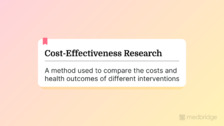
5. Cost-Effectiveness Research
This chapter explores methods for comparing the costs and health outcomes of different interventions using metrics like quality-adjusted life years (QALYs) and incremental cost-effectiveness ratio (ICER). Understanding these economic evaluations is crucial so clinicians can justify the value of their services and stakeholders can make informed resource allocation decisions in a complex healthcare economy.

6. Reporting Guidelines for Methodological Areas
This chapter introduces major reporting standards like CONSORT, PRISMA, and STROBE, and demonstrates how to utilize the EQUATOR Network to find appropriate guidelines. These standards are vital for ensuring research transparency, reproducibility, and high-quality peer review, ultimately improving the reliability of the evidence used in clinical practice.

7. Course Summary
The final chapter provides a comprehensive synthesis of the interconnected research designs covered throughout the course. This discussion reinforces the importance of using diverse methodologies to address multifaceted healthcare challenges and encourages participants to apply these insights to their own professional development and clinical environments.
More courses in this series
Rehabilitation Research Boot Camp: A Renewed Look at Evidence-Based Practice
Chad E. Cook
Rehabilitation Research Boot Camp: Research Methodology I
Kenneth E. Learman

Rehabilitation Research Boot Camp: Research Methodology II
Chad E. Cook
Rehabilitation Research Boot Camp: Statistical Analysis Essentials
Kenneth E. Learman

Rehabilitation Research Boot Camp: Why Critical Appraisal Skills Are Necessary
Chad E. Cook

Rehabilitation Research Boot Camp: Translating Research to Practice
Kenneth E. Learman
Rehabilitation Research Boot Camp: Navigating Grant Funding
Chad E. Cook
Rehabilitation Research Boot Camp: Publishing Case Reports and Series
Kenneth E. Learman
Frequently asked questions
Everything you need to know about Medbridge courses.
Who creates Medbridge courses?
We work with industry-leaders, top researchers, and consultants to build content roadmaps that are then structured into courses, filmed, and edited by our production team before being launched to our site.
How often does Medbridge release new courses?
New courses are added monthly and are automatically included in your subscription as they launch.
How often does Medbridge update courses?
Medbridge reviews its courses annually for relevance and to assess if content is up to date. Based on these reviews it may be determined that a course is out of date resulting in the course being re-filmed or retired, if the content is no longer needed (e.g. a replacement course already exists, the concepts are no longer best practice, etc.).
How many courses does Medbridge offer?
We have over 3,000 accredited courses and we are continually updating our library with new courses. Check our course library for the most up-to-date count for your discipline.
Are there any additional fees for taking a Medbridge course?
There are no additional fees for taking a Medbridge course, obtaining a course certificate of completion, earning CEUs as a subscriber, or accessing any of the additional tools your subscription may include.
Is there a limit to the number of courses I can take?
There is no limit to the number of courses you can take as a subscriber! As a subscriber to Medbridge, you have unlimited access to over 3,000+ accredited CE courses.
If you are a Premium subscriber, you also have unlimited access to our Patient Engagement Tools such as the Home Exercise Program, Patient Education Library, Orthopedic Exam Tests, and Manual Therapy Techniques. We have over 7,000 exercises and over 650+ videos and handouts of patient education resources with more exercises and patient education added to the library based on subscriber feedback, volume of request and specialities.
What is your refund policy?
You are eligible for a refund provided your request is received within 30 days of your subscription purchase and your account has no activity.