
Simplifying Performance Rehab Part 4: Managing Workload (Recorded Webinar)
Presented by Phil Plisky and Nate Denning

This course is a recording of a previously hosted live webinar event. Polling and question submission features are not available for this recording. Format and structure may differ from those of standard Medbridge courses.
This three-month, cohort-based program runs from October through December 2026 and is designed to help rehabilitation professionals build, apply, and advance their knowledge of sports performance rehabilitation with confidence. The program combines seven on-demand courses with three live mentorship webinars, offering structure, accountability, and real-world clinical application. Participants complete on-demand coursework, submit questions ahead of each webinar, and then join monthly mentorship webinars with instructors Phil Plisky and Nate Denning. The on-demand coursework follows four athletes on their recovery journeys, from a baseball player after ulnar collateral ligament repair to a basketball player with a lateral ankle sprain, as they walk through the phases of healing across all six domains of performance: movement, strength, power, speed, agility, and metabolic conditioning. Progressing an injured athlete back into performance and sport can be challenging. This introductory webinar addresses this industry gap by providing rehabilitation providers and strength and conditioning specialists with a simplified, data-driven approach to workload dosing and rehab programming. Participants will learn how to break download into external metrics (such as reps, sets, and practices) and internal stressors (such as sleep, diet, and stress). The course highlights how to calculate the acute: chronic workload ratio (ACWR) to target the optimal 0.8–1.2 injury-prevention “sweet spot”. Additionally, we will dissect critical detraining timelines: examining how a two-week versus a three-month layoff systematically degrades VO2 max, muscle mass, and power output. These interventions are mapped directly against the five phases of healing and tissue-specific recovery durations to ensure practitioners know exactly what to protect and what to program.
Learning Outcomes
- Differentiate between internal and external sources of athlete workload within a sports rehabilitation program
- Identify the metrics for acute workload and chronic workload to pinpoint the injury risk “sweet spot” using the acute:chronic workload ratio (ACWR)
- Compare the physiological impacts of detraining at two-week versus three-month thresholds and their effects on an individual's return to leisure sports and active recreation
- Group upper- and lower-body exercise patterns according to early power-training dosage guidelines to support structured physical activity routines
- Outline the five distinct phases of tissue healing to guide progressive rehabilitation programming after an athletic injury
Meet your instructors

Phil Plisky
Dr. Phil Plisky is a professor in the University of Evansville’s Doctor of Physical Therapy and PhD in Health Professions Education programs. He is the host of the Medbridge Rehab and Performance Lab podcast and founder of the Coaches Club at

Nate Denning
Dr. Nathan Denning is the founder of Integrated Performance and a partner at Athlete Development Solutions. His mission is to revolutionize human performance and rehabilitation through the integration of physical, mental, and educational support. Nate believes that peak performance—whether for an athlete or a clinician—is the…
Chapters & learning objectives
1. Workload Foundations and the ACWR
This chapter defines workload as the total stress placed on an athlete’s body, categorizing it into external and internal loading sources. It teaches clinicians how to define acute and chronic workloads and utilize the acute: chronic workload ratio (ACWR) to avoid sudden spikes in training intensity.
2. Healthy In-Season Performance Training
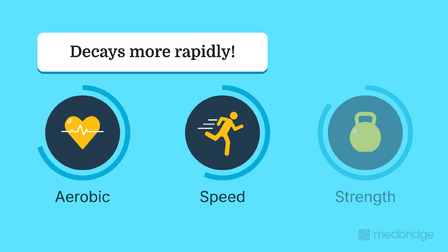
This chapter covers how an athlete becomes detrained over specific timelines, comparing the minor declines at two weeks to severe performance drops at three months (e.g., loss of peak power, max strength, and lean mass). It concludes with the framework for program design centered on the five phases of healing and tissue-specific recovery windows.

3. Question and Answer Session
This chapter is a viewer-submitted question and answer session facilitated by the course instructors, Nate Denning and Phil Plisky.
More courses in this series
Simplifying Performance Rehab Part 1: A Case-Based Series
Nate Denning and Phil Plisky

Simplifying Performance Rehab Part 2: Movement, Strength, and Power
Nate Denning and Phil Plisky

Simplifying Performance Rehab Part 3: Speed, Agility, and Metabolic Training
Nate Denning and Phil Plisky
Simplifying Performance Rehab Part 5: UCL Reconstruction
Nate Denning and Phil Plisky

Simplifying Performance Rehab Part 6: Shoulder Instability
Nate Denning and Phil Plisky

Simplifying Performance Rehab Part 8: ACL Reconstruction
Nate Denning and Phil Plisky
Simplifying Performance Rehab Part 9: Ankle Sprain
Nate Denning and Phil Plisky

Simplifying Performance Rehab Part 4: Managing Workload (Recorded Webinar)
Nate Denning and Phil Plisky
Frequently asked questions
Everything you need to know about Medbridge courses.
Who creates Medbridge courses?
We work with industry-leaders, top researchers, and consultants to build content roadmaps that are then structured into courses, filmed, and edited by our production team before being launched to our site.
How often does Medbridge release new courses?
New courses are added monthly and are automatically included in your subscription as they launch.
How often does Medbridge update courses?
Medbridge reviews its courses annually for relevance and to assess if content is up to date. Based on these reviews it may be determined that a course is out of date resulting in the course being re-filmed or retired, if the content is no longer needed (e.g. a replacement course already exists, the concepts are no longer best practice, etc.).
How many courses does Medbridge offer?
We have over 3,000 accredited courses and we are continually updating our library with new courses. Check our course library for the most up-to-date count for your discipline.
Are there any additional fees for taking a Medbridge course?
There are no additional fees for taking a Medbridge course, obtaining a course certificate of completion, earning CEUs as a subscriber, or accessing any of the additional tools your subscription may include.
Is there a limit to the number of courses I can take?
There is no limit to the number of courses you can take as a subscriber! As a subscriber to Medbridge, you have unlimited access to over 3,000+ accredited CE courses.
If you are a Premium subscriber, you also have unlimited access to our Patient Engagement Tools such as the Home Exercise Program, Patient Education Library, Orthopedic Exam Tests, and Manual Therapy Techniques. We have over 7,000 exercises and over 650+ videos and handouts of patient education resources with more exercises and patient education added to the library based on subscriber feedback, volume of request and specialities.
What is your refund policy?
You are eligible for a refund provided your request is received within 30 days of your subscription purchase and your account has no activity.