
Simplifying Performance Rehab Part 2: Movement, Strength, and Power
Presented by Phil Plisky and Nate Denning
This course is part of a series designed to be taken sequentially. It is recommended that learners view the series in the following course order:
- Simplifying Performance Rehab Part 1: A Case-Based Series
- Simplifying Performance Rehab Part 2: Movement, Strength, and Power
- Simplifying Performance Rehab Part 3: Speed, Agility, and Metabolic Training
- Simplifying Performance Rehab Part 4: Managing Workload (live webinar on October 21, 2026)
- Simplifying Performance Rehab Part 5: UCL Reconstruction
- Simplifying Performance Rehab Part 6: Shoulder Instability
- Simplifying Performance Rehab Part 7: Sport-Specific Progressions (live webinar on November 18, 2026)
- Simplifying Performance Rehab Part 8: ACL Reconstruction
- Simplifying Performance Rehab Part 9: Ankle Sprain
- Simplifying Performance Rehab Part 10: Putting It All Together (live webinar on December 9, 2026)
Register for all webinars: Cohort Series: Sports Performance Rehabilitation
Returning an injured athlete to sport requires more than restoring range of motion and baseline strength—it means rebuilding the movement, strength, and power qualities their sport actually demands. Many clinicians feel overwhelmed or inefficient when programming these qualities, and without a clear model for what a healthy athlete’s week should look like, athletes are too often returned to competition undertrained. This course builds that model from the ground up, using a healthy-athlete case as the template for weekly programming across movement, strength, and power. It grounds decisions in the language of strength and conditioning—periodization, training age, and load prescription—and works through the specifics: establishing bodyweight and kettlebell competency, building a strength reserve and shifting the force–velocity curve, selecting lifts and splits, prescribing intensity by strength phase, and training power with minimal fatigue and full acceleration. Physical therapists, athletic trainers, and other clinicians who program for athletes will be able to define return-to-sport benchmarks and construct a balanced week of movement, strength, and power training.
Learning Outcomes
- Define performance optimization parameters in a healthy athlete to establish baseline return-to-sport benchmarks
- Highlight the foundational building blocks of movement training and development required for athletic programming
- Outline the core principles and building blocks of strength development utilized in athletic conditioning
- Recall the physiological building blocks and essential components of power development in sports performance
- Outline a one-week training schedule incorporating movement, strength, and power progressions for a healthy athlete
Meet your instructors

Phil Plisky
Dr. Phil Plisky is a professor in the University of Evansville’s Doctor of Physical Therapy and PhD in Health Professions Education programs. He is the host of the Medbridge Rehab and Performance Lab podcast and founder of the Coaches Club at

Nate Denning
Dr. Nathan Denning is the founder of Integrated Performance and a partner at Athlete Development Solutions. His mission is to revolutionize human performance and rehabilitation through the integration of physical, mental, and educational support. Nate believes that peak performance—whether for an athlete or a clinician—is the…
Chapters & learning objectives

1. Terminology and Movement
This chapter establishes what “optimizing performance” means for a healthy athlete and equips clinicians with the strength-and-conditioning vocabulary (supercompensation; periodization across macro-, meso-, and microcycles; and training age) needed to program deliberately. It then defines the components of movement training: individualized warmup, corrective work, dynamic stretch, neural activation, and movement integration, along with the bodyweight and kettlebell competency every athlete needs. Grounding movement readiness as a programmable foundation rather than an afterthought gives clinicians a shared system for defining and building optimal movement.
2. Strength
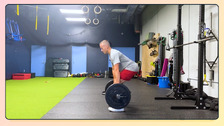
This chapter lays out the core principles of strength development: why strength matters through the concepts of strength reserve and the shifting force–velocity curve; how lifts are categorized into movement patterns and splits; and how volume and intensity are prescribed across hypertrophy, basic strength, and max strength phases. It walks through determining an athlete’s training age, finding a one-repetition max, programming rest, and structuring an in-season week. The result is a systematic way to prescribe strength that complements sport performance, keeps the athlete balanced, and respects tissue healing when applied in rehabilitation.

3. Power
This chapter defines power as high force applied at high velocity and distinguishes between the two types of power clinicians must train: muscular power and elastic power. It covers how to assess and develop power: appropriate loading at 0%–60% of one-repetition max, training in a minimally fatigued state, emphasizing full acceleration rather than the deceleration built into traditional lifting, and monitoring fatigue to guide volume. Understanding these principles allows clinicians to build the explosive qualities that sport demands that strength training alone does not produce and to sequence power work safely within the training week.
More courses in this series
Simplifying Performance Rehab Part 1: A Case-Based Series
Nate Denning and Phil Plisky

Simplifying Performance Rehab Part 2: Movement, Strength, and Power
Nate Denning and Phil Plisky

Simplifying Performance Rehab Part 3: Speed, Agility, and Metabolic Training
Nate Denning and Phil Plisky
Simplifying Performance Rehab Part 5: UCL Reconstruction
Nate Denning and Phil Plisky

Simplifying Performance Rehab Part 6: Shoulder Instability
Nate Denning and Phil Plisky

Simplifying Performance Rehab Part 8: ACL Reconstruction
Nate Denning and Phil Plisky
Simplifying Performance Rehab Part 9: Ankle Sprain
Nate Denning and Phil Plisky
Frequently asked questions
Everything you need to know about Medbridge courses.
Who creates Medbridge courses?
We work with industry-leaders, top researchers, and consultants to build content roadmaps that are then structured into courses, filmed, and edited by our production team before being launched to our site.
How often does Medbridge release new courses?
New courses are added monthly and are automatically included in your subscription as they launch.
How often does Medbridge update courses?
Medbridge reviews its courses annually for relevance and to assess if content is up to date. Based on these reviews it may be determined that a course is out of date resulting in the course being re-filmed or retired, if the content is no longer needed (e.g. a replacement course already exists, the concepts are no longer best practice, etc.).
How many courses does Medbridge offer?
We have over 3,000 accredited courses and we are continually updating our library with new courses. Check our course library for the most up-to-date count for your discipline.
Are there any additional fees for taking a Medbridge course?
There are no additional fees for taking a Medbridge course, obtaining a course certificate of completion, earning CEUs as a subscriber, or accessing any of the additional tools your subscription may include.
Is there a limit to the number of courses I can take?
There is no limit to the number of courses you can take as a subscriber! As a subscriber to Medbridge, you have unlimited access to over 3,000+ accredited CE courses.
If you are a Premium subscriber, you also have unlimited access to our Patient Engagement Tools such as the Home Exercise Program, Patient Education Library, Orthopedic Exam Tests, and Manual Therapy Techniques. We have over 7,000 exercises and over 650+ videos and handouts of patient education resources with more exercises and patient education added to the library based on subscriber feedback, volume of request and specialities.
What is your refund policy?
You are eligible for a refund provided your request is received within 30 days of your subscription purchase and your account has no activity.