
Bowel and Bladder Treatment for Older Children
Presented by Carina Siracusa
This course addresses the clinical complexities of managing pediatric bowel and bladder dysfunction through a collaborative, multiprovider lens. Practitioners frequently encounter pediatric patients with persistent issues like nocturnal enuresis and functional constipation, which often carry significant psychological and social burdens for the child and family. By exploring the specific roles of physical therapy, occupational therapy, speech-language pathology, and nursing, learners will understand how to leverage an interdisciplinary team to improve clinical outcomes. The training focuses on breaking down silos in pediatric care to ensure that sensory processing, behavioral routines, and physiological needs are addressed simultaneously. Attendees will gain practical strategies for cotreatment and professional communication to enhance the quality of life for children navigating these challenging conditions.
Learning Outcomes
- Identify what bowel and bladder conditions in children benefit from interdisciplinary treatment
- Identify cotreatment ideas for multiple disciplines with pediatric and early intervention therapy
- Compare treatment approaches for this population through case studies
- Design an interdisciplinary team for bowel and bladder issues in the pediatric population
Meet your instructor

Carina Siracusa
Dr. Carina Siracusa has been a practicing physical therapist since she graduated from Ohio University with her doctorate in physical therapy in 2005. She has practiced in the areas of pediatric, neurologic, oncologic, and pelvic floor physical therapy in her tenure as a physical therapist. She is an assistant professor at…
Chapters & learning objectives
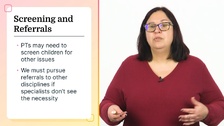
1. Interdisciplinary Treatment
Learners will examine the specific contributions of various healthcare disciplines in treating bowel and bladder disorders to foster better collaborative care. This chapter highlights how speech, occupational, and physical therapists can integrate their unique expertise into a unified treatment plan.
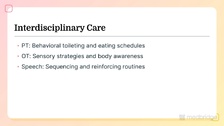
2. Case Studies
To foster better collaborative care, learners will examine the specific contributions of various healthcare disciplines in treating bowel and bladder disorders. This chapter highlights how speech, occupational, and physical therapists can integrate their unique expertise into a unified treatment plan.
More courses in this series
Bowel and Bladder Treatment for Infants
Carina Siracusa
Bowel and Bladder Treatment for Older Children
Carina Siracusa

Pelvic Floor Therapy in the Patient With CVA or MS
Carina Siracusa
Pelvic Floor Therapy for the Person With Spinal Cord Injury
Carina Siracusa
Physical Therapy for Pelvic Pain
Carina Siracusa
Physical Therapy for Pelvic Surgeries
Carina Siracusa
Frequently asked questions
Everything you need to know about Medbridge courses.
Who creates Medbridge courses?
We work with industry-leaders, top researchers, and consultants to build content roadmaps that are then structured into courses, filmed, and edited by our production team before being launched to our site.
How often does Medbridge release new courses?
New courses are added monthly and are automatically included in your subscription as they launch.
How often does Medbridge update courses?
Medbridge reviews its courses annually for relevance and to assess if content is up to date. Based on these reviews it may be determined that a course is out of date resulting in the course being re-filmed or retired, if the content is no longer needed (e.g. a replacement course already exists, the concepts are no longer best practice, etc.).
How many courses does Medbridge offer?
We have over 3,000 accredited courses and we are continually updating our library with new courses. Check our course library for the most up-to-date count for your discipline.
Are there any additional fees for taking a Medbridge course?
There are no additional fees for taking a Medbridge course, obtaining a course certificate of completion, earning CEUs as a subscriber, or accessing any of the additional tools your subscription may include.
Is there a limit to the number of courses I can take?
There is no limit to the number of courses you can take as a subscriber! As a subscriber to Medbridge, you have unlimited access to over 3,000+ accredited CE courses.
If you are a Premium subscriber, you also have unlimited access to our Patient Engagement Tools such as the Home Exercise Program, Patient Education Library, Orthopedic Exam Tests, and Manual Therapy Techniques. We have over 7,000 exercises and over 650+ videos and handouts of patient education resources with more exercises and patient education added to the library based on subscriber feedback, volume of request and specialities.
What is your refund policy?
You are eligible for a refund provided your request is received within 30 days of your subscription purchase and your account has no activity.