
Simplifying Performance Rehab Part 9: Ankle Sprain
Presented by Phil Plisky and Nate Denning
This course is part of a series designed to be taken sequentially. It is recommended that learners view the series in the following course order:
- Simplifying Performance Rehab Part 1: A Case-Based Series
- Simplifying Performance Rehab Part 2: Movement, Strength, and Power
- Simplifying Performance Rehab Part 3: Speed, Agility, and Metabolic Training
- Simplifying Performance Rehab Part 4: Managing Workload (live webinar on October 21, 2026)
- Simplifying Performance Rehab Part 5: UCL Reconstruction
- Simplifying Performance Rehab Part 6: Shoulder Instability
- Simplifying Performance Rehab Part 7: Sport-Specific Progressions (live webinar on November 18, 2026)
- Simplifying Performance Rehab Part 8: ACL Reconstruction
- Simplifying Performance Rehab Part 9: Ankle Sprain
- Simplifying Performance Rehab Part 10: Putting It All Together (live webinar on December 9, 2026)
Register for all webinars: Cohort Series: Sports Performance Rehabilitation
A lateral ankle sprain is often dismissed as a minor injury, yet delaying performance work can cost an athlete critical windows for restoring speed, power, and agility. This course applies performance programming to a real case—a 19-year-old Division II basketball player with a grade II lateral ankle sprain—and shows how to keep the whole athlete developing while the ligament heals. It defines the clinical goals and progression criteria for each phase, then details how power and plyometrics, speed, and agility are progressed from early rehab to return to sport, with strength and metabolic conditioning layered in. Along the way, it challenges common assumptions and emphasizes restoring closed-chain dorsiflexion and hip strength, not just the ankle. Physical therapists, athletic trainers, and other clinicians managing acute ankle injuries will be able to plan phase-specific goals and progress a complete performance program, treating rehabilitation and performance as one path rather than two.
Learning Outcomes
- Plan phase-specific clinical goals and progression criteria based on the physiological stages of healing following a lateral ankle sprain
- Implement core rehabilitation essentials necessary to protect and support adequate tissue healing of ligamentous ankle structures
- Modify lower extremity strength training progressions throughout the healing timeline to safely optimize an athlete’s return-to-sport readiness
- Apply power training and plyometric variables safely across all phases of lateral ankle tissue recovery
- Prioritize speed, agility, and metabolic conditioning pathways across the phases of healing to prepare the athlete for full sport return
Meet your instructors

Phil Plisky
Dr. Phil Plisky is a professor in the University of Evansville’s Doctor of Physical Therapy and PhD in Health Professions Education programs. He is the host of the Medbridge Rehab and Performance Lab podcast and founder of the Coaches Club at

Nate Denning
Dr. Nathan Denning is the founder of Integrated Performance and a partner at Athlete Development Solutions. His mission is to revolutionize human performance and rehabilitation through the integration of physical, mental, and educational support. Nate believes that peak performance—whether for an athlete or a clinician—is the…
Chapters & learning objectives
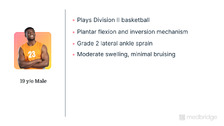
1. Lateral Ankle Sprain Instability: The Essentials
This chapter introduces the recurring case—a 19-year-old Division II basketball player with a grade II lateral ankle sprain—and establishes phase 1 priorities: beginning athlete development immediately; restoring closed-chain dorsiflexion; taping and bracing; balance work; starting performance drills as soon as the athlete is weight-bearing; and testing and restoring hip strength. It also examines the evidence on balance and proprioception, including why unstable-surface training shifts control to a hip strategy rather than targeting the ankle. Establishing these essentials protects the healing ligament, keeps the athlete progressing, and corrects a common misconception about balance training.

2. Power and Speed
This chapter details power and plyometric progressions from phase 2 to return to sport—advancing from lower-impact bilateral drills toward unilateral, depth, and reactive plyometrics—alongside speed progressions built on A and B series, sled and prowler work, and sprints. It emphasizes that speed can begin as soon as the athlete is weight-bearing. Because delaying speed and power work forfeits important neurological and physiological windows, progressing both of them early and in phases restores the explosive qualities that the athlete’s sport demands.
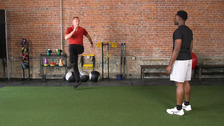
3. Agility
This chapter builds agility from its foundations—gait reeducation and wall and marching drills across linear, lateral, and crossover categories—through the fundamental change-of-direction strengths and into true, reactive agility that progresses from simple single-stimulus reactions to complex, chaotic, partner-driven cutting. Because agility can start as early as day one with slow assisted drills, developing the fundamentals rather than jumping to high-tech complexity prepares the athlete for the unpredictable demands of live sport.
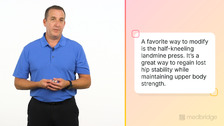
4. Strength and Metabolic Training
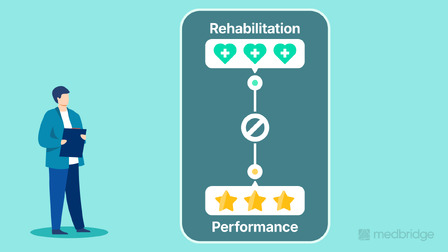
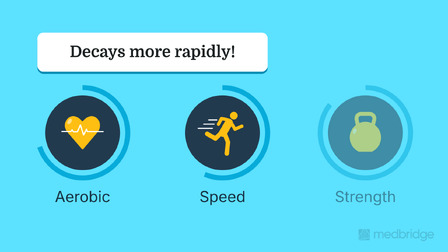
This chapter covers lower extremity strength progression and metabolic conditioning across the phases, including how quickly different performance qualities decay when training stops and how cross-training on a stationary bike, in a pool, or on an unweighted treadmill maintains conditioning with normal mechanics and low or no pain. Because qualities such as speed begin decaying within about a week, continuing to train strength and metabolic capacity and replacing missed practice load keeps the athlete ready and reinforces that rehabilitation and performance are one path, not two.
More courses in this series
Simplifying Performance Rehab Part 1: A Case-Based Series
Nate Denning and Phil Plisky

Simplifying Performance Rehab Part 2: Movement, Strength, and Power
Nate Denning and Phil Plisky

Simplifying Performance Rehab Part 3: Speed, Agility, and Metabolic Training
Nate Denning and Phil Plisky
Simplifying Performance Rehab Part 5: UCL Reconstruction
Nate Denning and Phil Plisky
Simplifying Performance Rehab Part 6: Shoulder Instability
Nate Denning and Phil Plisky

Simplifying Performance Rehab Part 8: ACL Reconstruction
Nate Denning and Phil Plisky
Simplifying Performance Rehab Part 9: Ankle Sprain
Nate Denning and Phil Plisky
Frequently asked questions
Everything you need to know about Medbridge courses.
Who creates Medbridge courses?
We work with industry-leaders, top researchers, and consultants to build content roadmaps that are then structured into courses, filmed, and edited by our production team before being launched to our site.
How often does Medbridge release new courses?
New courses are added monthly and are automatically included in your subscription as they launch.
How often does Medbridge update courses?
Medbridge reviews its courses annually for relevance and to assess if content is up to date. Based on these reviews it may be determined that a course is out of date resulting in the course being re-filmed or retired, if the content is no longer needed (e.g. a replacement course already exists, the concepts are no longer best practice, etc.).
How many courses does Medbridge offer?
We have over 3,000 accredited courses and we are continually updating our library with new courses. Check our course library for the most up-to-date count for your discipline.
Are there any additional fees for taking a Medbridge course?
There are no additional fees for taking a Medbridge course, obtaining a course certificate of completion, earning CEUs as a subscriber, or accessing any of the additional tools your subscription may include.
Is there a limit to the number of courses I can take?
There is no limit to the number of courses you can take as a subscriber! As a subscriber to Medbridge, you have unlimited access to over 3,000+ accredited CE courses.
If you are a Premium subscriber, you also have unlimited access to our Patient Engagement Tools such as the Home Exercise Program, Patient Education Library, Orthopedic Exam Tests, and Manual Therapy Techniques. We have over 7,000 exercises and over 650+ videos and handouts of patient education resources with more exercises and patient education added to the library based on subscriber feedback, volume of request and specialities.
What is your refund policy?
You are eligible for a refund provided your request is received within 30 days of your subscription purchase and your account has no activity.