
Stroke Boot Camp: How Do We Keep Progress Going in Chronic Stroke?
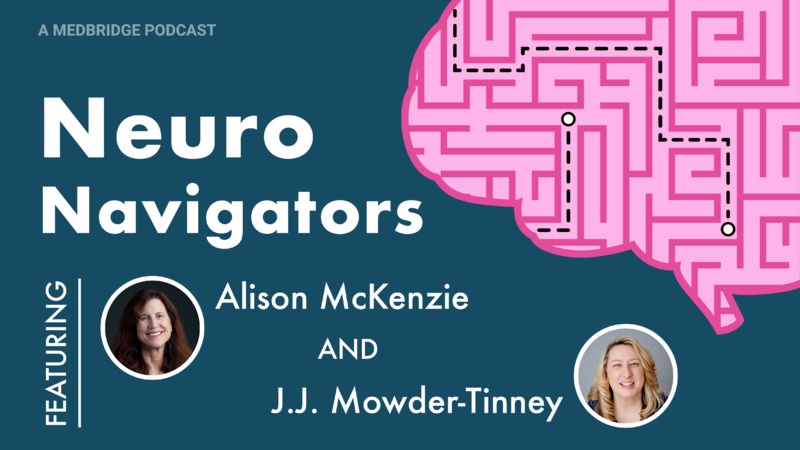
Presented by J.J. Mowder-Tinney and Alison McKenzie
Audio Runtime: 50 Minutes; Learning Assessment Time: 21 Minutes
Dr. Alison McKenzie, PT, DPT, PhD, FAPTA, a leading voice in neurorehabilitation and creator of Stroke Boot Camp, joins host J.J. Mowder-Tinney to explore how we can extend meaningful progress for people living with chronic stroke. Together, Alison and J.J. dive into the clinical reasoning, research, and real-world outcomes behind this high-intensity, interdisciplinary model. You’ll hear practical ideas to apply in your own setting, whether that’s a full boot camp or small-scale changes that shift the trajectory for your patients. Tune in to reimagine what’s possible beyond traditional rehab.
Learning Objectives
- Analyze the evidence around recommendations for optimal health management, wellness, and ongoing rehabilitation for individuals with chronic stroke
- Apply evidence-based, practical strategies to actionably address the delivery of short-term, high-intensity, interdisciplinary rehabilitation and wellness for individuals with chronic stroke
- Solve patient case scenarios involving plateau or decline in function over time in individuals who are aging with chronic stroke
This is an audio-only course. Additional materials are available for download within the course. To receive continuing education credit, complete the course and the accompanying quiz.
Meet your instructors

J.J. Mowder-Tinney
Dr. J.J. Mowder-Tinney holds a bachelor of science degree in psychology from the University of Colorado Boulder, a master of science in physical therapy from the University of Miami, and a doctorate in physical therapy from Nova Southeastern University. With nearly three decades of diverse clinical experience, her expertise…

Alison McKenzie
Dr. Alison McKenzie received her BS in physical therapy from the University of Utah (magna cum laude); her MA and PhD in anatomy, with a neuroscience emphasis, from the University of California at Berkeley; her postdoctoral training at the Universities of California at Berkeley and San Francisco; and her transitional DPT from…
Chapters & learning objectives
More courses in this series

What Is Happening With BPPV and Older Adults?
J.J. Mowder-Tinney and Jeff Walter

How Can You Enhance Mobility Using AFOs or FES After Stroke?
J.J. Mowder-Tinney and Jamie Haines

Is It Time to Redefine Fall Prevention for Persons With Parkinson’s Disease?
Valerie Carter and J.J. Mowder-Tinney

You Work Where? Practicing at Top of Scope in the Emergency Department
J.J. Mowder-Tinney and Rebekah Griffith

How Do We Sustain Support for Stroke Survivors and Caregivers Beyond Recovery?
J.J. Mowder-Tinney and Angie Reimer

How Do You Translate Effective Concussion Management Strategies Into Clinical Practice?
J.J. Mowder-Tinney and Rebecca Bliss

Are We Approaching Cueing Correctly?
Melissa Kimmerling and J.J. Mowder-Tinney

How Can You Make a Real Impact on Frailty, Deconditioning, and Sarcopenia?
Carole B. Lewis and J.J. Mowder-Tinney

How Can Poststroke Rehab Bridge the Gap Between Therapy and Real-Life Performance?
J.J. Mowder-Tinney and Darcy S. Reisman

What’s the Key to Maximizing Mobility in MS Patients?
J.J. Mowder-Tinney and Herbert Karpatkin

Can We Augment Recovery After SCI With Noninvasive Spinal Stimulation?
J.J. Mowder-Tinney and Candy Tefertiller

Can We Awaken Potential and Rethink What’s Possible in Disorders of Consciousness?
Jessica Asiello, Kristen Keech, and J.J. Mowder-Tinney

Hemianopia: What Do Clinicians Need to Know Now?
J.J. Mowder-Tinney and Mary Warren

Are You Missing These Useful Vestibular Management Strategies?
J.J. Mowder-Tinney and Jeff Walter

How Can We Think Differently About Dementia Care in Therapy?
J.J. Mowder-Tinney and Julie D. Ries
Is AI the Key to Smarter OT, PT, and SLP Rehab?
J.J. Mowder-Tinney and Sarah Brzeszkiewicz

Reactive Postural Control in OT/PT: Is It Time to Rethink Our Approach to Balance?
J.J. Mowder-Tinney and Nora Fritz
Exercise as Medicine: How Do We Apply PD-Specific Functional Training?
J.J. Mowder-Tinney and Becky Farley
Focal Dystonia: Can We Really Retrain the Brain?
Nancy Byl and J.J. Mowder-Tinney
Bridging Research and Practice: How Can You Implement Current Evidence?
J.J. Mowder-Tinney and Amy Yorke
Stroke Boot Camp: How Do We Keep Progress Going in Chronic Stroke?
J.J. Mowder-Tinney and Alison McKenzie
Can Motor Performance Be Driven By Cognition? The CO-OP Approach
J.J. Mowder-Tinney and Helene Polatajko
Spatial Neglect in Practice: What Should Guide Your Approach?
Dana Aravich and J.J. Mowder-Tinney
FND in Practice: What Myths Are Holding Us Back?
Julie Hershberg and J.J. Mowder-Tinney
The Power of Strategy: How Do We Optimize Independence?
J.J. Mowder-Tinney and Elizabeth Skidmore
Success in ALS/HD: How Do We Measure Progress When Decline Is Expected?
J.J. Mowder-Tinney and Matthew Caraher
High-Intensity Gait Training: Is It More Than Just Walking?
J.J. Mowder-Tinney and Annie Tapp
Trust in FND: What Builds It—and What Breaks It? (Live Podcast Recording)
Julie Hershberg and J.J. Mowder-Tinney
Strength in Stroke Rehab: Are We Missing an Opportunity?
J.J. Mowder-Tinney and Stacie Barber
Sensory Retraining: Is This the Missing Link in Functional Rehab?
J.J. Mowder-Tinney and Hadas Ofek
Task-Specific Training: A Catalyst or Constraint in Functional Restoration?
J.J. Mowder-Tinney and Edelle Field-Fote
Spatial Neglect: How Do We Uncover the Layers?
J.J. Mowder-Tinney, Dave Katz, and Melissa Zarn
Frequently asked questions
Everything you need to know about Medbridge courses.
Who creates Medbridge courses?
We work with industry-leaders, top researchers, and consultants to build content roadmaps that are then structured into courses, filmed, and edited by our production team before being launched to our site.
How often does Medbridge release new courses?
New courses are added monthly and are automatically included in your subscription as they launch.
How often does Medbridge update courses?
Medbridge reviews its courses annually for relevance and to assess if content is up to date. Based on these reviews it may be determined that a course is out of date resulting in the course being re-filmed or retired, if the content is no longer needed (e.g. a replacement course already exists, the concepts are no longer best practice, etc.).
How many courses does Medbridge offer?
We have over 3,000 accredited courses and we are continually updating our library with new courses. Check our course library for the most up-to-date count for your discipline.
Are there any additional fees for taking a Medbridge course?
There are no additional fees for taking a Medbridge course, obtaining a course certificate of completion, earning CEUs as a subscriber, or accessing any of the additional tools your subscription may include.
Is there a limit to the number of courses I can take?
There is no limit to the number of courses you can take as a subscriber! As a subscriber to Medbridge, you have unlimited access to over 3,000+ accredited CE courses.
If you are a Premium subscriber, you also have unlimited access to our Patient Engagement Tools such as the Home Exercise Program, Patient Education Library, Orthopedic Exam Tests, and Manual Therapy Techniques. We have over 7,000 exercises and over 650+ videos and handouts of patient education resources with more exercises and patient education added to the library based on subscriber feedback, volume of request and specialities.
What is your refund policy?
You are eligible for a refund provided your request is received within 30 days of your subscription purchase and your account has no activity.